Modernization as a Factor of Revolutionary Destabilization in Historical Process and in Modern Africa
скачать Автор: Grinin, Leonid - подписаться на статьи автора
Журнал: Journal of Globalization Studies. Volume 17, Number 1 / May 2026 - подписаться на статьи журнала
DOI: https://doi.org/10.30884/jogs/2026.01.01
Leonid E. Grinin
HSE University, Moscow, Russia; Institute of Oriental Studies, Russian Academy of Sciences, Moscow, Russia
In the contemporary World System there are many revolutions in its periphery and especially in African countries. The causes of large part of these revolutions are connected with special state of these societies, because they are in their period of modernization. In this article is discussed some important processes connected with revolutions in modernizing societies on the theoretical level which can help to understand much better and deeply revolutionary process in different modern countries. The core element of the modernization process is industrialization and associated deep changes. This gives an opportunity to escape from the Malthusian trap, which is characterized for a complex agrarian society and associated with the lag of productive forces behind the population's growth rate, i.e. with insufficiently rapid technological growth and generally insufficient dynamism of changes. But in the process of escape from the Malthusian trap it, as well as in the process of changing society, there is a great danger of falling into a different type of trap – a modernization trap. The modernization trap, on the contrary, is the result of excessively rapid changes, to which a number of societal important relations and institutions do not have time to adapt. Because of the inability of many traditional institutions, relations, and ideologies to keep up with changes in technology, communications, the system of education, the medical sphere, and demographic structures, strong prerequisites for a revolutionary crisis emerge. Thus from the point of view of the world-historical process, revolutions are not coincidental in a sense that they are especially characteristic of a certain phase of societal development when among many transformations modernization is also present. The author proposes typology of modernization traps as in historical process at whole. Among them, the youth-bulge and Urbanization traps are still influential among African countries. The author also proposes new typology of modernization traps which especially are characterized for African societies (weak state trap, ethno-secessionist trap, Islamist trap).
Keywords: revolution, revolutionary process, modernization, modernization traps, Malthusian trap, industrialization, urbanization, World System, failed states, radicals, Islamists.
1. Revolutions and Modernization Period
Elsewhere we showed (Grinin 2022a, 2022b, 2022d; Grinin A., Grinin L. 2025), with the advent of the Modern era, revolutions became not only one of the means of changing socio-political regimes but also an important accelerator of development both of certain advanced societies and of the World System in general. It is no surprise that they became a landmark phenomenon in socio-political transformations of the Modern period. Thus, in terms of the world historical process, revolutions (starting from the early Modern period) can be considered as a regularity intrinsic to a certain stage of a society's development (see Goldstone et al. 2022b; Grinin 2022a, 2022b, 2022d, 2022e; see also Grinin 2018a, 2018b, 2018c, 2019b). This stage is often defined as a modernization period witnessing changes in many societal relations which gradually (but in comparison with previous time quite quickly) transform societies from archaic into modern ones. However, such transitional periods often proceed with crises. The latter are a consequence of the inability of many traditional institutions and social relations, as well as ideologies, to keep up with changes in technology, communications, the education system, medicine, and demographic structures. This results in growing radical sentiments in society and a revolutionary crisis.
Revolutions occurred prior to the beginning of the Modern period. They may also break out in societies which completed their modernization rather long ago. Besides, revolutions may occur due to some other causes including the fight for independence or against authoritarian regimes.1 However, in this article we mostly deal with classical-type revolutions which are more closely associated with societal modernization. The suggested idea about the relation between revolutions and the modernization period is that just in this period (a) revolutions occur more frequently; (b) the role of revolutions increases since they become the means of developmental advance of societies; and (c) revolutions may be treated as a result of abrupt changes in societies which unfold (usually in an uncontrollable way) in the process of its complex and contradictory development, in particular in cases of catching-up (i.e. accelerated) development. However, it would be an oversimplification to state that modernization generates revolution. The relationship between revolutions and modernization undoubtedly exists but it is indirect and much more complex than it is often suggested.2 In the present article we show the critical mechanism of this relationship.
There are a number of studies which investigate the relations between revolutions and the degree of modernization of a society (see, e.g. Brunk et al. 1987; Burkhart and Lewis-Beck 1994; Cutright 1963; Dahl 1971; Epstein et al. 2006; Goldstone 2001, 2014; Hobsbawm 1996; Huntington 1968, 1986; Lipset 1959; Londregan and Poole 1996; Mau and Starodubrovskaya 2001; Moore 1966; Rueschemeyer et al. 1992; Tilly 1986; Boix 2011).3 There exist diametrically opposed views on the character of these relations (see, e.g., Huntington-Tilly's debate [Huntington 1986; Tilly 1986]). One should note that the researchers' views to a great degree depend on their attitude towards the very concept of modernization.
Modernization is a vague and tendentious concept (Tilly 1986: 48). ‘Instead of trying to pace off modernization precisely, I shall ordinarily substitute for it somewhat better defined processes, such as industrialization or demographic expansion’ – Tilly added (Ibid.). However, the changing aspects are numerous in a modernizing society and they are closely related to each other. So it would be inefficient to consider them in isolation. On a large temporal scale or in the world-system context, it would be more convenient to apply a term that would cover the whole range of the interrelated transformations. Thus, Tilly (Ibid.: 57) finally admits that, though indirectly, population growth, industrialization, urbanization, and other large-scale structural changes do, to be sure, affect the probabilities of revolution. Besides he pointed out that the mobilization of new groups into politics (or into a revolution) occurs as a more or less direct effect of rapid social and economic change (Ibid.: 50). And what are industrialization, urbanization, population growth, rapid social and economic change, and other large-scale structural changes if not the different facets of modernization?
So, similar to other broad concepts the term ‘modernization’ has its drawbacks. Yet, I maintain that its advantages outweigh the drawbacks, since it gives a definite perception concerning the direction and rate of a society's development. I agree on this point with Tipps that the notion of modernization must be sought not in its clarity and precision as a vehicle of scholarly communication, but rather in its ability to evoke generalized images which serve to summarize all the various transformations of social life attendant upon the rise of industrialization and the nation-state (Tipps 1973: 199).
Therefore, it will be more reasonable to make a conclusion that one should better understand the relationship between modernization and revolutions not as a direct and specific cause of revolutions but as their main foundation. And this becomes all the more meaningful if one accounts for what we have said in (Grinin 2022d) about the division of a revolutionary situation into a general situation (which can last for a long period, for many years and even decades) and a much shorter particular situation (see Fig. 3.1 in Grinin 2022d). Modernization can hardly affect the particular revolutionary situation since these are two different phenomena in type, duration and scale; but it can produce a strong impact on the origin of a general revolutionary situation and its exacerbation.4
Thus due to the inability of many traditional institutions and relations, as well as ideologies, to keep up with changes in economy, technology, urbanization, demography and other rapid and uncontrolled transformations caused by modernization, there emerges a strong probability of a structural crisis.
All together the major changes in these factors create structural vulnerability to the danger of social upheavals like revolutions. To be sure, revolutions may start due to some other reasons or they may break out in rather modernized societies. There are also a number of examples when no revolutions occurred in countries during their modernization period. This explains why there hardly exists a direct correlation between modernization and revolutions (Goldstone 2014). However, despite these variations, the modernization transition, in our opinion, is still the most dangerous period in this context.
As to those cases of countries with rapid modernization accompanied by drastic population growth, yet without revolution we can say that sometimes it may be explained by a state’s more or less successful domestic and foreign policy (e.g., Japan after the Meiji Restoration or Egypt in the nineteenth – beginning of the twentieth century). This means that at a certain stage of development a society manages to escape the modernization trap. However, in the context of modernization and rapid demographic growth the cases of crisis-free development should be considered more as an exception that needs special explanation, while revolutions and political upheavals are the typical phenomena observed. This conclusion leads us to introduce the notion of the modernization trap, which is an expected social-political crisis resulting from modernization which a society faces when trying to overcome its backwardness (see Grinin 2012b). In what follows we present a detailed description of the correlation between the Malthusian and modernization traps as well as of the different types of modernization traps.
2. The Processes and Types of Modernization
The concept
of modernization covers a wide range of subjects and its exact definition is disputable
(Apter 1965; Black 1966; Eisenstadt 1966, 1978; Grinin 2010a, 2013b; Grinin and
Korotayev 2015; Huntington 1968; Levy 1966, 1967; Nefedov 2007; Poberezhnikov
2006; Przeworski and Limongi 1997; Rostow 1971; Smelser 1967; Tipps 1973;
Travin and Margania 2004; Yakovlev 2010; see also Bendix 1967; Collins 1968). Despite this variety, for this chapter we define
it as follows. Modernization is the process of a society's (and of the whole World System's)
transition from archaic (supercomplex agrarian) to industrial society (and
currently, to industrial-informational society). The term may also refer to a group of related societies (as it was in disunited
Italy and Germany in the nineteenth century) and to the whole World
System if we take the period when such transition occurred for the first time (i.e. among most of developed societies).
This process is continuous enough for every society (lasting at least
for several decades, sometimes over a hundred or more years) and all the more
continuous for the World System (see below). With respect to the World System
we can speak about the early modernization
(in the sixteenth – eighteenth centuries), classical modernization (the
nineteenth and the beginning of the twentieth centuries), modern modernization
(in the 1910–1960s),
and postmodern modernization (the 1970s – nowadays). The early modernization
correlates with the catching-up divergence (see Grinin and Korotayev
2015), the classical and modern ones
correlate with the Great Divergence (see e.g.,
Goldstone 2002b, 2009); the postmodern correlates with the Great Convergence (Grinin and
Korotayev 2015). Each period of modernization has its own fundamental
peculiarities and relations with evolution (see below). Moreover, the
relationship between early modernization (the early
Modern era) and early revolutions is much more complex and ambiguous. The great
revolutions in the Netherlands (in the 1560s), Britain (the 1640s), even the
future US (1776) and France (1789) all occurred before there was any shift to
markedly higher GDP per capita and before steam industrialization. Within these
revolutions the defined relationship was heavily complicated by the religious
ideology, archaic social system and absence of nations and of the modern type
state or the mature one (see Grinin 2022e; Tsygankov 2022; see also Grinin
2008, 2011, 2012b). The most obvious relationship with revolutions is traced
for the periods of the classical and modern modernization (see Grinin 2022a,
2022c; Grinin and Grinin 2022a).
The process of modernization is accompanied by accelerated social development and is usually characterized by the following features:
• development of a dominant commercial sector and monetization;
• industrial development;
• urbanization (a transition to societies with a large part of the population living in cities);
• modernization in agriculture;
• spread of mass education, the establishment of modernized health service, and propagation of sanitary culture and hygienic norms;
• significant changes in demographic development, the so-called demographic modernization (i.e. the first and the second phase of the demographic transition);
• transition to the economic model of continual growth of volume of output as well as capital and income on the base of continual technical improvement. This model was closely connected with economic cycles of a new type.
Besides, modernization ultimately requires significant political, legal and social transformations which political elites often resist. This may be the main cause of modernization crises (see below).
Modernization also significantly changes and often splits the elite, some part of which can start supporting revolutionary changes. This reinforces the revolutionary crisis, increases the chances of successful mobilization of the masses and weakens the government. Thus, revolutions can be viewed as the result of drastic changes in the development process which lead to a great variety of societal tensions and conflicts.5
As we noted above, the modernization processes cover quite a long period, and in every society they have their own peculiarities (Berger 1986). However, one can distinguish several types of modernization: a natural-historical, a catching-up modernization, and a forced one.
A natural-historical modernization occurs without external impact. It can unfold only in societies which are first to launch the process. In their case modernization can take a long time. Such pioneer societies lack models and must cope with new challenges by trial and error. Consequently, the dramatic changes in social structure, in particular, the growing urbanization and literacy, can cause acute tensions and social conflicts. As a result of falling into modernization traps, such societies experience revolutions. Since in such pre-industrial societies there was a relatively high level of urbanization, this type of modernization trap will be further referred to as an urbanization trap, proposed as a subtype of the modernization trap (see below).
However, much more often a society's modernization is associated with catch-up development by, accelerated industrialization or rapid joining of international division of labor, when the already existing industrial and sociopolitical management technologies are borrowed. In this situation, on the one hand, the process of transformation accelerates, but, on the other hand, many necessary reforms fail. Thus, great disproportions arise in a society, since modernization involves, first of all, the military sphere, technology and economy, while privileges, the distribution system, archaic political and social structures may change much more slowly.6
Sometimes a forced (imposed from outside) modernization can take place, but it more frequently happens that only certain phases or modes of implementation are externally imposed rather than the entire process. This can be illustrated by the example of Egypt under English occupation (1882–1919), Japan under American occupation (after 1945), and India in the late period of British Raj. For the purposes of the chapter, it is worth noting that a society undergoing forced modernization often succeeds in avoiding social explosion for a long time (though they can at last break out as happened in Egypt in 1919 and in India in 1942–1947; see Grinin and Grinin 2022a). In many African countries, modernization began as a forced process, as the colonial authorities (and their businesses) were interested in developing these countries for more productive exploitation and management (for details see Grinin A., Grinin L. 2025).
3. The Malthusian and Modernization Traps
It is also important to emphasize that modernization is tightly connected with an escape from the Malthusian trap although unfortunately this aspect of modernization is insufficiently studied and rarely mentioned.
The Malthusian trap (as we define it) implies a situation when a society fails to technologically resolve the problem of sustaining the growth of agricultural output at a faster rate than the population increases.7 In this situation an agrarian society actually exhausts its potential. In the pre-industrial period, the supercomplex societies' attempts to overcome resource restrictions typically resulted in their falling into the Malthusian trap. The escape from the Malthusian trap started with the first phase of the Industrial Revolution in the sixteenth century and in advanced European countries it ended with the completion of this Revolution (see Grinin 2007a, 2007b; Grinin and Grinin 2015, 2016; Grinin and Korotayev 2009a, 2015; Grinin et al. 2009; Grinin, Korotayev, Malkov 2008 for more details). In the nineteenth and twentieth centuries most social systems managed to escape the Malthusian trap (see the references in Endnote 7). Thus, in the World System core the escape took a very long period of three centuries, from the second half of the sixteenth century to the mid-nineteenth century (the landmark is the abolition of the Corn Laws in 1847 in Great Britain). In the late nineteenth century, the international division of labor became so advanced that some societies could specialize in industrial production while making up for food shortages with imports. Thus, a growing number of states started their escape from the Malthusian trap. The final escape from the Malthusian trap took place in Europe with the global agrarian crisis (in the 1870–1890s), which led to a continuous price reduction or stagnation for basic grains, thus clearly demonstrating a qualitative change in the World System (Grinin et al. 2009; Grinin, Korotayev, Malkov 2010; Grinin and Korotayev 2012a).
Still even now there are some societies, especially in Tropical Africa, that have failed to fully escape it (however, they are seriously moving to the exit from it; see Endnote 7).
3.1. The Societal Contradiction Generated by the Modernization Process and the Threat of Revolutions
The escape from the Malthusian trap together with a society's transformation brings great danger of falling into a trap of another type – the modernization one. And while the Malthusian trap is associated with the lag of productive forces behind the population's growth rate (i.e., with their insufficiently rapid growth and generally low dynamics of changes), the modernization trap is, on the contrary, a result of sweeping changes which leave a number of important relations and institutions behind.
The following disproportions emerge as result of the
transformation process:
(1) shifts in the size and incomes of various economic groups, generally
creating a deeply unequal income distribution among social groups and regions
(leading to under consumption in some strata, groups, and regions); (2) the
maldistribution of resources and population within society (e.g., when with an overall sufficiency
of farmland, some districts face an acute problem of land shortage and rural
overpopulation); (3) disproportions in the population age structure (see
below); (4) resistance on the part of outdated, but influential institutions (e.g., religious movements or
institutions, in particular, like the Islamic institutions [Grinin 2019a],
craftsmen or peasants' organizations, the Russian peasant community may be
a well-known example here [see Grinin 2017a, 2017b]); (5) the authorities'
self-interested reaction to increasing resources, in particular their interest
in international adventures; (6) growing literacy and education levels create a
powerful group of intellectuals who try to ideologically influence the whole of
society; (7) increasing expectations among different sections of the
population, which often fail to be realized in full. This range of changes
tends to destroy traditional ideology and authorities.
Generally speaking, the escape from the Malthusian trap actually means that the population on average improves its living standards (as evidenced, e.g., by increasing average values of per capita calorie intake or rising life expectancies). However, actual improvements are often highly disproportionate, and combined with other social distortions; certain crisis situations are fraught with revolution. The increasing contradictions and revolutionary spirits are also fueled by the population's growing expectations (see below).
3.2. Types of Modernization Traps at the Escape from the Malthusian Trap
Since the World System core generally needed much time to escape from the Malthusian trap, it is not surprising that we observe an evolution of the modernization trap itself. This is the reason for working out a classification of traps. The main types of modernization traps emerging in the process of escaping from the Malthusian trap are presented in Figure 1.
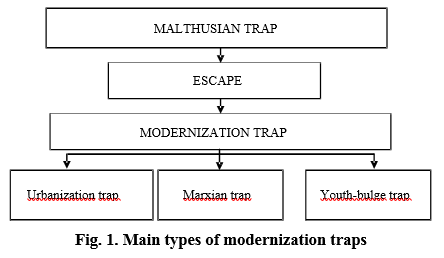
Urbanization trap. At first, the Malthusian trap can evolve into the one that can be called an urbanization trap. It primarily affects pre-industrial societies with a relatively high urbanization level and an established bourgeoisie. In such societies, there is no machine industry yet, but there exist different forms of early capitalist trade and industrial enterprise. But the main point is that urbanization reaches the level beyond which some serious societal transformations are indispensable. At the same time the political elite hardly realizes this whereas some citizens, bourgeoisie, and intellectuals come out as a vanguard of public opposition. Our investigations show that in modernizing societies most of such tensions arise at an urbanization rate from 10 to 30 % (Grinin, Korotayev, Malkov 2008; Grinin et al. 2009; Grinin and Korotayev 2009b).
The urbanization trap correlates with early modernization (in the sixteenth to eighteenth centuries), which we call a natural-historical modernization (see above). Britain before the Revolution of 1640 is the first example of this dynamic pattern. Another example is France on the eve of the French Revolution of 1789. Yet, in Britain, distinctly from France, great progress was made in the agricultural sector (see Apostolides et al. 2008; Grinin and Korotayev 2015; Grinin, Korotayev, Malkov 2008; Grinin et al. 2009; Goldstone 1984, 2009; Overton 1996; Trevelyan 1978),8 which probably was one of the reasons for the peasants’ relative inactivity during the revolutionary period.
The main difference that political crises and political actions against authorities in the situation of an urbanization trap display (in comparison with rebellions in the late-agrarian estate societies [Grinin 2022b]) consists in the following: there is an aspiration to spread the action nation-wide and give it a definite ideological character. Moreover, another evident difference is the aspiration to change the existing social system and create a new national body of power. Moreover, the upper urban strata, including counter-elites and a part of the elite that believes it has no real power commensurate with its importance (e.g., ‘What is the Third Estate? Everything! What has it been in the political order? Nothing!’), make the core of such movements (for the social structure of revolutionary masses see, e.g., Sorokin 1992: 286). These strata are united by a new ideology. In other words, the urbanization trap means a transition from urban rebellions and peasant wars to social revolutions.
Malthusian-Marxian trap and the Marxian trap. The Marxian trap is a situation of weakly regulated exploitation of the emerging working class and a consequent fierce class struggle leading to dangerous social destabilization. However, the transition to the Marxian trap occurs far from immediately and only at the stage of intense industrialization.
The transition from the Malthusian trap to the Marxian one occurs during the start of industrialization (i.e., the last phase of Industrial revolution, see Grinin and Grinin 2015, 2016; Grinin and Korotayev 2015; Grinin, Grinin, Korotayev 2024), when the factory industry emerges and the industrial proletariat becomes a noticeable (but still rather small in number) social layer. The Malthusian-Marxian trap emerges when the demographic pressure in a society is great while the society is still in the course of transition from feudalism to capitalism (Grinin 2010b, 2017a; Grinin and Korotayev 2012a; Grinin et al. 2008: 81).
One can distinguish two main constituents of this trap: the economic (Marxian) and demographic (Malthusian). Its Malthusian component provides a relatively cheap labor force, and Marxian component is connected with a high level of exploitation. In industrialized societies, a large and relatively redundant rural population is a source of serious demographic pressure.9
Thus, here the structural-demographic constituent acts not in the direct Malthusian form, but as a producer of socially explosive material in the form of an unsatisfied proletariat and urban community. The entrepreneurs get their labor force from the seemingly inexhaustible reserve of workers and the demographic pressure constantly emits new workers to towns.
The Marxian component arises from the disproportion in distribution of benefits from rapid economic growth and from the lack of social legislation; and all that makes the workers powerless and the exploitation often becomes barbaric. In short, the rapid dynamics of economic development and changes in social life require serious transformations in the political system and legislation, but these transformations can seriously lag behind. These disproportions are one of the most common reasons for revolutions.
A more specific reason is that most of the new members of the working class have few or no skills. Therefore, a disparity emerges between demand for a skilled labor force and an excessive offer of a non-skilled labor force, and as a consequence a large gap grows in the income of workers of different groups. During periods of economic growth, employers are often ready to increase wages, yet in the periodic crises the demand for workers, especially the unskilled ones, significantly decreases and the danger of social unrest grows.
But with the development of capitalist industrialization and the growth of class struggle, the Malthusian-Marxian trap turns into a typical Marxian trap (Grinin 2010b, 2012b, 2013a, 2017a, 2017b; Grinin and Korotayev 2012a). The Marxian trap can be resolved by means of (a) social reforms; (b) completed industrialization; (c) completed demographic transition (birthrate reduction); (d) achievement of a certain degree of democratization which yet is far from complete.
As we pointed out above, a sharp increase of the urban population share in the demographic structure may also cause social tensions. In the situation of a Marxian trap among the urban population, it is the middle-class and proletariat that actively participate in revolutionary events. Samuel Huntington places the middle-class in the first place, especially the intellectuals with traditional background and modern values which are followed by salary earners (Huntington 1968) while the working class is placed in the second place (Ibid.). Yet, in his study Huntington focuses on the society of his epoch (i.e., of the 1940–1960s) adding that in the nineteenth century the proletariat used to be much more radical in European countries (Ibid.). In fact, in the nineteenth and early twentieth centuries it was workers and employees who were the revolutionary impact force and actively employed such means as mass protests or general strikes.
Thus the modernization process proceeded far from smoothly and easily in most countries. ‘Modernity breeds stability, but modernization breeds instability’ (Huntington 1968: 41). It is only after passing through the modernization period that a society gains immunity (yet, not permanent) to certain types of crises.
The youth-bulge is always associated with social-demographic factors and is a result of modernization. Due to modernization, growing food production together with improved medical care reduces mortality and sharply increases the proportion of youths (aged from 15 to 29 years old),10 i.e. there appears a so-called youth bulge, which is presented in the diagrams showing the proportion of young people relative to the total adult population or total population (Figure 2).
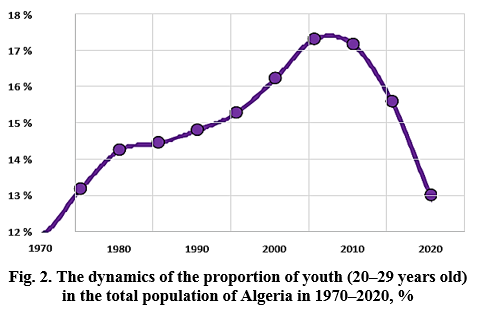
Source: UN Population Division 2021.
Such a change in the age structure with the onset of modernization creates conditions for social-political instability. According to Jack Goldstone most twentieth-centu-ry revolutions in developing countries occurred in societies with exceptionally large youth bulges (Goldstone 1991, 2002a: 11–12; see also Fuller 2004; Grinin 2013a; Grinin, Issaev, Korotayev 2016; Heinsohn 2003; Mesquida and Weiner 1999; Moller 1968).11
In many countries, including African ones (especially the North-African, which are more developed among African countries) such large youth cohorts who benefit from more education and higher aspirations as part of modernization, but yet are unable to find satisfactory employment or political roles, play a key role (especially at the present stage) in creating a continuity of political instability in society after the escape from the Malthusian trap. That is why we propose to call this type of modernization trap the youth-bulge trap. (About the mechanism of falling into such a trap in the process and/or as a result of the escape from the Malthusian trap see Grinin, Korotayev, Malkov 2010; Grinin 2011; Korotayev 2014; Korotayev, Zinkina et al. 2011; Korotayev, Malkov, Grinin 2014). The youth-bulge trap is typical for the first phase of the demographic transition (it can also operate at its final stage or at the beginning of its second phase). It appears due to a rapid reduction of infant and child mortality with the birth rate remaining high (Grinin and Korotayev 2012b; Korotayev, Bozhevolnov et al. 2011). The results of this reduction in child mortality and several-fold growth in the number of surviving children can lead to considerable increase of youth cohorts as part of the population structure within 15–20 years. As a result, each generation is much more numerous than their parents' generation. The effect of this trap is reinforced by rapid urbanization processes (Grinin, Korotayev, Malkov 2010; Grinin and Korotayev 2009b).
In the past centuries, ‘youth bulges’ were observed as part of the development of many modernizing states. However, currently the great progress in medicine has reduced infant and child mortality to unprecedentedly low rates. Additionally, in a number of contemporary developing countries (even in the medium-developed countries) the consumption level has substantially increased in comparison with previous years. That is why today with other conditions being equal, the youth share (and correspondingly the scale of the youth bulge) is larger than in previous epochs. Consequently, nowadays for a number of developing countries the danger of falling into the youth trap is in some respects even larger in comparison with the previous period (but at the same time due to historical experience and the international community's aid the danger can also be reduced). Today political analysts speak about the countries with a young age structure (the youth bulge) as forming an ‘arc of instability’ stretching from the Andes region in Latin America across Africa (especially south of the Sahara), then across the Middle East and the northern regions of South Asia (The World after the Crisis … 2009: 59). Such fears came true with respect to Tunisia, Libya, Egypt, Syria, Yemen, and other Arab countries in 2010–2011 (see Grinin and Korotayev 2022a, 2022b; see also Grinin 2022b; Grinin, Issaev, Korotayev 2016; Grinin, Korotayev, and Tausch 2019; Kuznetsov 2022; Korotayev and Zinkina 2022; Akhmedov 2022; Barmin 2022; Issaev et al. 2022; Korotayev et al. 2022). 12.
The combined modernization trap. It is worth noting that traps of the above mentioned types are rarely observed in pure form. This is more typical of a natural-historical modernization. As for a catch-up modernization, a combined trap type usually emerges, which only increases instability, conflict, and the risk of revolution. Thus, the urbanization trap always emerges during the period of modernization, but the later the historical period in which a country modernizes, the more powerful the urbanization trap becomes in combination with other types of modernization traps: with the Marxian trap and the youth trap. Russia in the early twentieth century was a striking example of such a combined modernization trap, which was one of the main reasons for such a powerful revolution. In modern African countries, there is a potent mixture of the urbanization trap and the youth trap, which, given their huge populations, creates the basis for serious destabilization. In some cases, this combination in African countries also includes the Malthusian-Marxian trap.
4. Africa, Modernization and Revolutions
Elsewhere we argued that in some sense we can expect that the twenty-first century will be the African century (Grinin 2020a, 2020b, 2020c; Grinin, Korotayev 2023, 2024; Grinin A., Grinin L. 2025; Grinin L. and Grinin A. 2026). The reasons are that Africa is the most rapidly growing continent and the growth and development of African societies (demographic, economic, cultural, national etc.) will bring at the same time both challenges and opportunities. The growth of the African economy is inevitable already in connection with the growth of the population, especially urban one, and its escape from extreme poverty; yet, this can increase inequality in societies. We also discussed problems of current and future instability in many African countries, connected with rapid growth, modernization, weakness of statehood and national historical experience, traditions and so on.
We stressed that explosive and rapid modernization contributes to the accelerated development of African countries, but it also creates considerable instability in many societies, which should be taken into account, etc. That is why we predict that in the twenty-first century Africa will be the most turbulent continent in the World System, with the highest number of revolutions, conflicts, and explosions of extremism.
So even a brief analysis of a number of factors characteristic for the current state and development of many African countries suggests that Africa will be the most restless continent in the 21st century. These factors include the following: a) insufficient maturity of political relations and public administration; b) archaism of the economy and social relations; c) ongoing processes of modernization and urbanization; d) Africa, including the Sahel and North Africa, become a territory of increasing geopolitical rivalry between major powers.
However, it is worth giving additional explanations (for details see also Grinin A., Grinin L. 2025; Grinin L. and Grinin A. 2026). Let us try to expand on the answer to the question of why modernization in African countries is particularly fraught with revolutions, as well as, of course, other forms of destabilization, including military coups, guerrilla and civil wars, separatism, terrorism, and the like. It is important that these forms of destabilization often merge in African realities. In particular, many protests begin as mass civil unrest and end in military coups and regime change.13 Revolutions often take the form of guerrilla or civil wars, mass terror, and the like. Moreover, they can drag on for many years and even decades.
The reasons for the particular sensitivity of African societies to modernization in terms of the emergence of instability, including revolutionary instability, are as follows:
1) African modernization is accelerated modernization. Underdevelopment is so great that the rate of change is inevitably high or very high with respect to society's ability to adapt.
2) African modernization is expanded modernization. We mean that virtually every sphere and sub-sphere of life and public administration is modernized, so the modernization front is exceptionally broad.
3) Besides, accelerated and expanded modernization is going under strongly complicated circumstances.
Let us describe these complicated circumstances. They rather considerably complicate peaceful and quiet transition to the state of developed society.
1. An exceptional level of backwardness. If we analyse all cases of modernization in different countries and different periods, we find that none of them lagged behind the advanced countries to the same extent as the vast majority of African countries lagged behind European countries and the United States.
2. A situation of weak statehood. If we continue to analyse the above-mentioned cases of historical modernizations in different societies, it is crucial to note that we do not find instances of such weak and underdeveloped statehood as it was and still is the case in many African countries. On the contrary, statehood traditions have been more or less strong in every modernised country in other regions of the world while there is the very limited historical experience of statehood among African countries (see Grinin, Grinin, Korotayev 2024). Today, only a few countries could be compared to some African countries, such as Libya, the Democratic Republic of Congo, the Central African Republic, and others in terms of weak statehood development, these are perhaps only Afghanistan or Yemen, which have failed to modernize and are in a state of profound destabilization. As our research shows, there is a correlation between the duration of historical experience of statehood and the resilience of society to destabilization, that is, the shorter the experience, the greater the risk of destabilization (see Grinin, Grinin, Korotayev 2024). The lack of experience of statehood leads to the fact that many countries of Tropical Africa are weak or failed states, unable to resist criminal and terrorist groups, and protect their own population (as we see in Mali, Niger and other countries in Sahel and other African regions.).
3. A situation of immature ethnicity. Modernization often leads to a situation when the previously economically and culturally backward regions and peoples within multinational empires or states develop to the level where their national self-identity awakens. And this paves the way for their struggle for political equality, autonomy and even the desire to break free of larger states and create independent states. As a result, most national liberation revolutions in a certain sense were more or less prepared by transformations associated with modernization (see Grinin 2022c; Grinin and Grinin 2022b; Filin et al. 2022), inasmuch as nationalism is yet another product of changes in literacy, communications, and social relations (see Grinin 2022c; see also Gellner 1983; Grinin 2008).
The same process occurs with the immature ethnicity of numerous African peoples. As national consciousness grows, many African ethnic groups begin to perceive themselves as nations mature enough to aspire to independence or at least broad autonomy, especially in provinces rich in minerals or of strategic importance. However, the level of ethno-national organization in Africa does not yet correspond to the usual level of nations embarking on the path to modernization, which is explained by the continent's general backwardness, its colonial past, weak statehood, artificially established borders, and exceptionally rapid demographic growth in the last 50–70 years. The latter has blown all proportions so that peoples, who were mentally united primarily by tribal principles, became populous nations led by highly active politicians. While in previous periods, such a level of power was typically represented by associations of hundreds of thousands, today tribal associations comprise millions, and sometimes tens of millions, of people. Tribalism is incompatible with the level of modernizing societies, leading to many difficulties, but especially to preference of an ethno-tribal but not the whole country interest as well as the entrenched principle of appointing people primarily from their own ethnic groups to government positions. Overall, this leads to further weakness of states and the growth of separatism and national revolutions.
Tribalism outside of Africa exists globally only in the countries listed above and in some provinces within certain countries, such as Balochistan in Pakistan and Iran. However, it is very important that tribalism in African countries has the status of a crucial institution and a factor influencing all major spheres of life. Of course, tribalism also modernizes, adapting to change and development. Therefore, one could say that it has in a state of severe overmaturity for a long time, analogous to normal national relations in other countries. However, this process of the development of political tribal nations (ethnicities) into political state nations has an extremely serious impact on both modernization and destabilization processes. More about the role and influence of immature statehood and ethnicity on destabilization see in Grinin 2020a; Grinin et al. 2024).
4. Accelerated modernization under high demographic pressure. Many destabilizing events, including revolutions, are linked to demographic factors. High demographic pressure has long been considered a critical destabilizing factor (see Goldstone 1991, 2002a; Grinin, Korotayev 2022b; Grinin 2020b). We have already discussed above youth traps, as a widespread type of modernization trap (see also Grinin 2012a, 2013a, 2013b, 2014, 2019b, 2022a; see also Korotayev, Bozhevolnov et al. 2011). The Arab Spring was a demonstration of the impact of such traps (Grinin and Korotayev 2022b).
A rapid population growth in Africa was the primary reason why the average annual per capita GDP growth was negative in 30 countries on the continent in the 1980s and in 25 countries in the 1990s (Bessonov 2010: 58). However, since the 2000s, the gradual development of economies and institutions, along with the integration of African countries into the global market and increasing globalization, have reversed this trend.
5. Accelerated modernization under strong Islamist radical revolutionary activity. This refers not to all but to a half of African societies, where Islam is predominated or wide spread. We have pointed out (Grinin, Grinin 2022b; Grinin 2020c, 2020d, 2021) that the phenomenon of the Islamic renaissance, together with a wide spread of Islamism, actually creates an important basis for destabilization, since it generates radicalism as its extreme wing. In the Sahel and beyond, Islamism is largely undeveloped. As a result, these societies proved to be susceptible to radicalism and terrorism, on the one hand, because radicals from the Middle East and North Africa can quite easily recruit supporters and volunteers here, and on the other hand, because these countries (due to abovementioned reasons: their lack of experience, the insufficient level of development of the state apparatus, a rapidly growing population, including urban, the so called youth bulges and other reasons) appeared to be helpless against terrorists in many respects. As a result, some of them have become bases for the spread of terror. However, these radicals can be regarded as revolutionaries because they have a special (though radical and terrorist) ideology, the goal to overthrow the civil regime and impose a style of life according the Quran and the Sharjah. This is also a way to modernization, though this is a religious and very narrow modernization. Of course, the increasing threat of Islamist revolutionary-terrorist radicalism poses the problem (which is beginning to be solved in some places) of strengthening statehood in the countries of Tropical Africa. However, the fight against terrorism and extremism contributes to the development of statehood in many countries, the modernization of the system of governance, armed forces, police, etc.
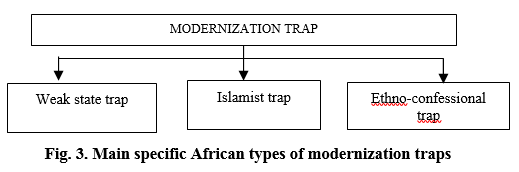
So, it is not surprising that a significant number of African countries find themselves in modernization traps. In addition to the three traps mentioned above (urbanization trap, Marxian trap, and youth-bulge trap), we can add the following traps specific to African countries: 1) Weak-state trap, 2) Islamist trap, and 3) Ethno-confessional trap.
All of them are quite characteristic of Africa, although they can also be observed in other parts of the Global South. They are presented in Figure 3.
5. Conclusion
In conclusion, we may summarize that during the modernization period rapid and uncontrolled changes together with increasing structural disproportions and demographic pressure can lead a society into an emergent – modernization – trap. Such factors as weakness of statehood and ethno-separatist movements also greatly influence destabilization and hamper national building. These disproportions can also be enhanced by rapid urbanization and growing expectations; the latter surpass the society's opportunities and are taken especially hard against the background of growing inequality. It is worth mentioning also inevitable nepotism, corruption and ethno-tribal privileges, the rise of religious radicalism. All together these factors increase the danger of the disruption of social equilibrium (e.g., Goldstone 2014; Johnson 1968; Smelser 1963) that can lead to significant destabilizing processes, including revolutions, separatism, and civil wars. Thus, the fundamental roots of revolutions mostly lie in serious disproportions emerging in a society's development which result from accelerated modernization.
As we have already pointed out, modernization in every society has a certain type and aspect, so that the same institutions (depending on their development and society's peculiarities) may both reduce the threat of revolution and increase its danger. That is why African countries both with unstable democratic and with authoritarian regimes are vulnerable to revolutions.14
It makes sense to conclude this article by emphasizing that modernizing countries can be more easily drawn into a wave of revolution than countries that have already modernized. The list of countries that experienced the Arab Spring confirms this. It is worth noting that revolutionary waves have occurred quite frequently in recent decades. In particular, we identified three such waves in the twenty-first century alone, which significantly affected African countries (see Grinin and Grinin 2022b; Goldstone et al. 2024).
Funding
The study has been carried out within the framework of the HSE Fundamental Research Program in 2026 with the support of the Russian Science Foundation (project No. 24-18-00650).
NOTES
1 As a result, today revolutions may break out in already modernized societies, in which case their main causes are the incongruences between society's self-identification (and the respective adopted values) and its political organization (see Inglehart and Welzel 2005; Grinin and Korotayev 2016). On the other hand, there are a number of cases where democratic revolutions occurred in societies that were underdeveloped for them, for example, as happened in 1905–1911 in Iran or in 1911 in China. This can happen due to the world-system impact when in ideological and political terms the revolutionaries start to get ahead of the developmental level of their society. See more details in Grinin 2022d; Grinin and Grinin 2022a.
2 In this context Goldstone is surely right when arguing that modernization has no consistent relationship to the onset of revolutions (Goldstone 2014: 12).
3 See also our studies of the complex relationship between the processes covered by the terms of modernization and revolutions (e.g., Grinin 2012a, 2013b, 2017a, 2017b; Grinin and Korotayev 2012a, 2012b; Korotayev et al. 2011; Korotayev et al. 2017).
4 It seems that in his arguing against Huntington’s idea about correlation between modernization and revolutions (Huntington 1968, 1986), Tilly made the same mistake in his structure and agency approach on revolutions, i.e. mixed short-run and a long-run analyses (Karasev 2022).
5 About the splitting of elites and other abovementioned processes see (Goldstone et al. 2022b) and Grinin 2022d.
6 Such catching-up modernization leads to cultural borrowings and then sooner or later to importation of revolutionary ideologies. As a result, in the catching-up countries indigenous leaders started to consider revolutions (similar to democracy) as a certain universal and advanced means to rise to a new level. Such a world-system effect allows revolutions to engage peripheral countries which are not objectively ready for such forms of advancement (see about this Grinin 2022b).
7 This may at times mean a decline of living standards for a considerable part of population and even their balancing at the edge of physical survival (see, e.g., Artzrouni and Komlos 1985; Kögel and Prskawetz 2001; Komlos and Artzrouni 1990; Steinmann and Komlos, 1988; Steinmann et al. 1998; Wood 1998; see also Grinin et al. 2008; Grinin and Korotayev 2012a). It is important to emphasize that such situation has been observed in many African countries for a long time but in the recent decades the growth of crop yields in general does not lag behind and in general even outpaces population growth.
8 Between 1600 and 1750, labor productivity noticeably increased, approximately twofold (see Dennison and Simpson 2010: 150, Table 6.2).
9 On the other hand, it is worth noting that Marxian traps are far from always connected with the problems of powerful demographic pressure and rapid population growth. In nineteenth century France, for example, the population grew comparatively slowly, increasing only by 50 %, from 26.9 to 40.7 million (Armengaud 1976: 29). But that did not prevent several revolutions in France during the nineteenth century.
10 But of course, the more mature (up to 35 years of age) cohorts of youth also play an active part in protests.
11 About the role of youth bulges in the Arab Spring see Grinin and Korotayev 2022b; Korotayev and Zinkina 2022.
12 It should be noted that over the past decade, the birth rate and total fertility rate in North African countries have been slowing down, albeit at different rates in different countries. Therefore, the youth bulge is generally the result of a previous birth peak. However, many African countries not only have higher total fertility rates, but the peak of their youth bulges is still ahead. Consequently, the role of youth modernization traps has not yet been fully played out for them.
13 This form is called a coup d'état. Recently, in 2025, a coup d'état occurred in Madagascar, for the second time (Taukumova 2026). Coup d'état, like military coups, is characteristic of countries where the military play a greater role than usual, and civilian authority is insufficiently institutionalized or stable, i.e., of many African countries.
14 We already considered the correlation between revolutions and democracy in (Grinin and Korotayev 2022a). Still we would like to point to further examples when democracy prevented revolution, and when it prepared the prerequisites for its outbreak. On the one hand, many modernizing societies are to a certain extent authoritarian and possess a rigid structure. That is why they are more prone to revolutionary breaks in contrast to the societies in which social discontent can be canalized in legal (i.e., democratic) forms. For example, in 1848 in Europe and Britain there was observed a rise of social activities. In Britain, peaceful forms (Chartism) would prevail while Continental Europe faced revolutions (see Grinin 2022c). On the other hand, in our opinion the most dangerous in terms of social upheavals are the situations of partial (non-institutionalized) democracy when the zero-sum game starts between the authoritarian and radical forces and also when influential radical forces, which are not democratic in their nature and views, use democratic freedoms and elections to take power. That was the case in Russia in 1917 and in Germany in 1933. Such situations continue to take place (see Grinin and Grinin 2022a). This also happened in Egypt after the Islamists' victory at the 2011–2012 elections (see Grinin and Korotayev 2022a; Grinin and Korotayev 2022b; Korotayev and Zinkina 2022; see also Goldstone et al. 2022a).
REFERENCES
Akhmedov, V. 2022. The Syrian Revolution. In Goldstone J. A., Grinin L., and Korotayev A. (eds.), Handbook of Revolutions in the 21st Century: The New Waves of Revolutions, and the Causes and Effects of Disruptive Political Change (pp. 707–723). Springer. https://doi.org/10.1007/978-3-030-86468-2_27.
Apostolides, A., Broadberry, S., Campbell, B., Overton, M., and van Leeuwen, B. 2008. English Agricultural Output and Labour Productivity, 1250–1850: Some Preliminary Estimates. http://www. basvanleeuwen.net/bestanden/agriclongrun1250to1850.pdf.
Apter, D. E. 1965. The Politics of Modernization. University of Chicago Press.
Armengaud, A. 1976. Population in Europe 1700–1914. In Cipolla C. M. (ed.), The Industrial Revolution. 1700–1914 (pp. 22–76). Harvester.
Artzrouni, M., and Komlos, J. 1985. Population Growth through History and the Escape from the Malthusian Trap: A Homeostatic Simulation Model. Genus 41 (3–4): 21–39.
Barmin, Y. 2022 Revolution in Libya. In Goldstone J. A., Grinin L., and Korotayev A. (eds.), Handbook of Revolutions in the 21st Century: The New Waves of Revolutions, and the Causes and Effects of Disruptive Political Change (pp. 725–738). Springer. https://doi.org/10.1007/978-3-030-86468-2_28.
Bendix, R. 1967. Tradition and Modernity Reconsidered. Comparative Studies in Society and History 9 (3): 292–346.
Berger, P. L. 1986. The Capitalist Revolution. Basic Books.
Bessonov S. A. 2010. Directions
and Mechanisms for the Development of a Market Economy. In Abramova, I. O.,
Morozenskaya, E. V. (eds.), The Economy
of Africa in the Context of Market Transformations (pp. 48–60). Moscow: N.p. Original
in Russian (Бессонов, С. А. Направления и механизмы
развития рыночной экономики. В: Абрамова, И. О., Морозенская, Е. В. (отв.
ред.), Экономика Африки в условиях
рыночных преобразований С. 48–60.
М.: Б. и. URL:
https://www.inafran.ru/sites/default/
files/page_file/ekonomika_afriki_v_usloviyah_rynochnoy_ekonomiki.pdf).
Black, C. E. 1966. The Dynamics of Modernization: A Study in Comparative History. Harper Torchbooks.
Boix, C. 2011. Democracy, Development, and the International System. American Political Science Review 105 (4): 809–828. https://doi.org/10.1017/S0003055411000402.
Brunk, G. G., Caldeira, G. A., and Lewis-Beck, M. S. 1987. Capitalism, Socialism, and Democracy: An Empirical Inquiry. European Journal of Political Research 15 (4): 459–470.
Burkhart, R. E., and Lewis-Beck, M. S. 1994. Comparative
Democracy: The Economic Development Thesis. American Political Science
Review 88 (4):
903–910. https://doi.org/
10.2307/2082715.
Collins, R. 1968. A Comparative Approach to Political Sociology. In Bendix R., et al. (eds.), State and Society: A Reader in Comparative Political Sociology (pp. 42–67). Little & Brown.
Cutright, P. 1963. National Political Development: Social and Economic Correlates. In Polsby N. W., Dentler R. A., and Smith P. A. (eds.), Politics and Social Life: An Introduction to Political Behavior. Houghton Mifflin.
Dahl, R. A. 1971. Polyarchy: Participation and Opposition. Yale University Press.
Dennison, T., Simpson. J. 2010. Agriculture. In Broadberry S., and O’Rourke K. H. (eds.), The Cambridge Economic History of Modern Europe. 1700–1870 (Vol. 1, pp. 147–163). Cambridge University Press.
Eisenstadt, S. N. 1966. Modernization: Protest and Change. Prentice-Hall.
Eisenstadt, S. N. 1978. Revolution and the Transformation of Societies: A Comparative Study of Civilizations. Free Press.
Epstein, D. L., Bates, R., Goldstone, J., Kristensen, I., and O’Halloran, S. 2006. Democratic Transitions. American Journal of Political Science 50 (3): 551–569.
Filin, N., Khodunov, A., and Koklikov, V. 2022. Serbian ‘Otpor’ and the Color Revolutions' diffusion. In Goldstone J. A., Grinin L., and Korotayev A. (eds.), Handbook of Revolutions in the 21st Century: The New Waves of Revolutions, and the Causes and Effects of Disruptive Political Change (pp. 465–482). Springer. https://doi.org/10.1007/978-3-030-86468-2_17.
Fuller, G. E. 2004. The Youth Crisis in Middle Eastern Society. Institute for Social Policy and Understanding.
Gellner, E. 1983. Nations and Nationalism. Blackwell.
Goldstone, J. A. 1984. Urbanization and Inflation: Lessons from the English Price Revolution of the Sixteenth and Seventeenth Centuries. The American Journal of Sociology 89 (5): 1122–1160.
Goldstone, J. A. 1991. Revolution and Rebellion in the Early Modern World. University of California Press.
Goldstone, J. A. 2001. Toward a Fourth Generation of Revolutionary Theory. Annual Review of Political Science 4: 139–187. https://doi.org/10.1146/annurev.polisci.4.1.139.
Goldstone, J. 2002a. Population and Security: How Demographic Change can Lead to Violent Conflict. Journal of International Affairs 56 (1): 3–22.
Goldstone, J. A. 2002b. Efflorescences and Economic Growth in World History: Rethinking the ‘Rise of the West’ and the British Industrial Revolution. Journal of World History 13: 323–389. https:// Doi.Org/10.1353/Jwh.2002.0034.
Goldstone, J. A. 2009. Why Europe? The Rise of the West in World History. 1500–1850. McGraw-Hill.
Goldstone, J. A. 2014. Revolutions: A Very Short Introduction. Oxford University Press.
Goldstone, J. A., Grinin, L., Korotayev, A. 2022a. Conclusion. How Many Revolutions will we See in the 21st Century? In Goldstone J. A., Grinin L., and Korotayev A. (eds.), Handbook of Revolutions in the 21st Century: The New Waves of Revolutions, and the Causes and Effects of Disruptive Political Change (pp. 1033–1057). Springer. https://doi.org/10.1007/978-3-030-86468-2_41.
Goldstone, J. A., Grinin, L., and Korotayev, A. 2022b. The Phenomenon and Theories of Revolutions. In Goldstone J. A., Grinin L., and Korotayev A. (eds.), Handbook of Revolutions in the 21st Century: The New Waves of Revolutions, and the Causes and Effects of Disruptive Political Change (pp. 37–68). Springer. https://doi.org/10.1007/978-3-030-86468-2_2.
Goldstone, J. A., Grinin, L., Ustyuzhanin, V. V., Korotayev, A. V. 2024. Revolutionary Events of the 21st Century: The Preliminary Quantitative Analysis. Istoriya i sovremennost 1: 3–26. DOI: 10.30884/iis/2024.01.01. In Russian (Голдстоун, Дж. А., Гринин, Л. Е., Устюжанин, В. В., Коротаев, А. В. Революционные события XXI века: предварительный количественный анализ. История и современность 1: 3–26).
Grinin A. L., Grinin L. E. 2025. Modernization in African Countries and Destabilization Processes. Journal of Globalization Studies 16 (2): 3–28. DOI: 10.30884/jogs/2025.02.01.
Grinin, L. 2007a. Production Revolutions and the Periodization of History. Herald of the Russian Academy of Sciences 77 (2): 150–156.
Grinin, L. 2007b. Production Revolutions and Periodization of History: A Comparative and Theoretic-Mathematical Approach. Social Evolution & History 6 (2): 75–120.
Grinin, L. 2008. Early State, Developed State, Mature State: The Statehood Evolutionary Sequence. Social Evolution & History 7 (1): 67–81.
Grinin, L. E. 2010a. The State and the Historical Process. The Evolution of Statehood: From the Early State to the Mature One. 2nd ed. Moscow: LIBROKOM. Original in Russian (Гринин, Л. Е. Государство и исторический процесс. Эволюция государственности: от раннего государства к зрелому. 2-е изд. М.: ЛИБРОКОМ).
Grinin, L. 2010b. Malthusian-Marxian Love and Russian Revolutions. In Grinin L., Korotayev A., and Malkov S. Yu. (eds.), History and Mathematics: On the Causes of the Russian Revolution (pp. 198–224). LKI/URSS. Original in Russian (Гринин Л. Мальтузиано-Марксова любовь и русские революции. В сб. Л. Гринин, А. Коротаев и С. Ю. Малков (ред.), История и математика: О причинах русской революции (стр. 198–224). ЛКИ/УРСС).
Grinin, L. 2011. From the Malthusian Trap to the Modernization Trap: Forecasting the Dynamics of Political Instability in the Countries of the World-System Periphery. In Akayev A., Korotayev A., Malinetsky G., and Malkov S. (eds.), Projects and Risks of the Future. Concepts, Models, Tools, Forecasts (pp. 337–356). URSS. Original in Russian (Гринин Л. Из мальтузианской ловушки в ловушку модернизации. К прогнозированию динамики политической нестабильности в странах мир-системной периферии. В: А. Акаев, А. Коротаев, Г. Малинецкий и С. Малков (ред.), Проекты и риски будущего. Концепции, модели, инструменты, прогнозы (с. 337–356). УРСС).
Grinin, L. E. 2012a. The Arab Spring and the Reconfiguration of the World System. In Korotaev, A. V., Zinkina, Yu. V., Khodunov, A. S. (eds.), Systemic Monitoring of Global and Regional Risks (pp. 188–223). Moscow: LIBROCOM/URSS. Original in Russian (Гринин, Л. Е. Арабская весна и реконфигурация Мир-Системы. В: Коротаев, А. В., Зинькина, Ю. В., Ходунов, А. С. (ред.), Системный мониторинг глобальных и региональных рисков. М.: ЛИБРОКОМ/URSS. С. 188–223).
Grinin, L. 2012b. State and Socio-Political Crises in the Process of Modernization. Cliodynamics 3 (1): 124–157. https://doi.org/10.21237/C7clio3112323.
Grinin, L. 2013a. State and Socio-Political Crises in the Process of Modernization. Social Evolution & History 12 (2): 35–76.
Grinin, L. E. 2013b. The State and Crises in the Process of Modernization. Filosofiya i obshchestvo 3: 29–59. Original in Russian (Гринин, Л. Е. Государство и кризисы в процессе модернизации. Философия и общество 3: 29–59).
Grinin, L. E. 2014. Modernization (post-Malthusian) Traps. In: Grinin, L. E., Korotaev, A. V. (eds.), History and Mathematics: Aspects of Demographic and Socio-Economic Processes (pp. 98–127). Volgograd: Uchitel. Original in Russian (Гринин, Л. Е. Модернизационные (постмальтузианские) ловушки. В: Гринин, Л. Е., Коротаев, А. В. (отв. ред.), История и Математика: аспекты демографических и социально-экономи-ческих процессов. Волгоград: Учитель. С. 98–127).
Grinin, L.E. 2017a. The Russian Revolution and the Traps of Modernization. Polis. Political Studies 4: 138–155. Original in Russian (Гринин, Л. Е. Русская революция и ловушки модернизации. Полис. Политические исследования 4: 138–155).
Grinin, L.E. 2017b. The Russian Revolution in Light of Modernization Theory. Istoriya i sovremennost' 2: 22–57. Originally in Russian (Гринин, Л. Е. Российская революция в свете теории модернизации. История и современность 2: 22–57).
Grinin, L. 2018a. Revolutions and Historical Process. Journal of Globalization Studies 9 (2): 126–141. https://doi.org/10.30884/seh/2019.02.14.
Grinin, L. 2018b. Revolutions, Historical Process, and Globalization. Vek globalizatsii 4: 16–29. Original in Russian (Гринин Л. Революции, исторический процесс и глобализация. Век глобализации 4: 16–29)
Grinin, L. 2018c. Revolutions: An Insight into a Five Centuries' Trend. Social Evolution & History 17 (2): 171–204.
Grinin, L. 2019a. Islamism and Globalization. Journal of Globalization Studies 10 (2): 21–36.
Grinin, L. 2019b. Revolutions in the Light of Historical Process. Social Evolution & History 18 (2): 260–285.
Grinin, L. E. 2020a. The Movement Towards Sustainable Democratic Relations and the Nation State as a Long-Term Factor of Potential Destabilization in the Countries of the Afro-Asian Macrozone of Instability. In Grinin, L. E., Korotayev, A. V., Bykanova, D. A. (eds.), Systemic Monitoring of Global and Regional Risks: Yearbook. Part 2 (pp. 694–724). Volgograd: Uchitel. Original in Russian (Гринин, Л. Е. Движение к устойчивым демократическим отношениям и национальному государству как длительный фак-тор возможной дестабилизации в странах афразийской макрозоны нестабильности. В: Гринин, Л. Е., Коротаев, А. В., Быканова, Д. А. (отв. ред.), Системный мониторинг глобальных и региональных рисков: ежегодник. Ч. 2. Волгоград: Учитель. C. 694–724).
Grinin, L. E. 2020b. Demographic Processes as a Basic and Long-Term Factor of Potential Destabilization in the Countries of the Afro-Asian Macrozone of Instability. In Grinin, L. E., Korotayev, A. V., Bykanova, D. A. (eds.), Systemic Monitoring of Global and Regional Risks: Yearbook. Part 1 (pp. 179–197). Volgograd: Uchitel. Original in Russian (Гринин, Л. Е. Демографические процессы как базовый и длительный фактор возможной дестабилизации в странах Афразийской макрозоны нестабильности. В: Гринин, Л. Е., Коротаев, А. В., Быканова, Д. А. (отв. ред.), Системный мониторинг глобальных и региональных рисков: ежегодник. Ч. 1. C. 179–197. Волгоград: Учитель).
Grinin, L. E. 2020c. The Movement of Societies towards Mature Socio-Political and Economic Relations as a Long-Term Factor of Possible Destabilization in the Countries of the Afro-Asian Macrozone of Instability. In Grinin, L. E., Korotayev, A. V., Bykanova, D. A. (eds.), Systemic Monitoring of Global and Regional Risks: Yearbook. Part 2 (pp. 666–693). Volgograd: Uchitel. Original in Russian (Гринин Л. Е. Движение обществ к зрелым социально-политическим и экономическим отношениям как длительный фактор возможной дестабилизации в странах Афразийской макрозоны нестабильности. Системный мониторинг глобальных и региональных рисков: ежегодник. Часть 2 / Отв. ред. Л. Е. Гринин, А. В. Коротаев, Д. А. Быканова. Волгоград: Учитель. C. 666–693).
Grinin, L. E. 2020d. Radical Islamism, the Religious Factor, and Destabilization in the Countries of the Afro-Asian Macrozone of Instability. In Grinin, L. E., Korotayev, A. V., Bykanova, D. A. (eds.), Systemic Monitoring of Global and Regional Risks: Yearbook. Part 2 (pp. 810–828). Volgograd: Uchitel. Original in Russian (Гринин, Л. Е. Ради-кальный исламизм, религиозный фактор и дестабилизация в странах афразийской макрозоны нестабильности. В: Гринин, Л. Е., Коротаев, А. В., Быканова, Д. А. (отв. ред.), Системный мониторинг глобальных и региональных рисков: ежегодник. Ч. 2. Волгоград: Учитель. C. 810–828).
Grinin, L. E. 2021. How Islamism Influences Modernization and Processes in the Islamic World. In Korotayev, A. V., Grinin, L. E., Malkov, S. Yu. (eds.), Socio-Political Desta-bilization in the Countries of the Afro-Asian Macrozone of Instability: Quantitative Analysis and Risk Forecasting (pp. 68–85). Moscow: Lenand. Original in Russian (Гринин, Л. Е. Как исламизм влияет на модернизацию и процессы в исламском мире. В: Коротаев, А. В., Гринин, Л. Е., Малков, С. Ю. (отв. ред.), Социально-политиче-ская дестабилизация в странах афразийской макрозоны нестабильности: коли-чественный анализ и прогнозирование рисков. М.: Ленанд. С. 68–85).
Grinin, L. 2022a. Evolution and Typology of Revolutions. In Goldstone J. A., Grinin L., and Korotayev A. (eds.), Handbook of Revolutions in the 21st Century: The New Waves of Revolutions, and the Causes and Effects of Disruptive Political Change (pp. 173–200). Springer. https://doi.org/ 10.1007/978-3-030-86468-2_6.
Grinin, L. 2022b. Revolutions and Historical Process. In Goldstone J. A., Grinin L., and Korotayev A. (eds.), Handbook of Revolutions in the 21st Century: The New Waves of Revolutions, and the Causes and Effects of Disruptive Political Change (pp. 139–171). Springer. https://doi.org/10.1007/978-3-030-86468-2_5.
Grinin, L. 2022c. The European revolutions and Revolutionary Waves of the 19th Century: Their Causes and Consequences. In Goldstone J. A., Grinin L., and Korotayev A. (eds.), Handbook of Revolutions in the 21st Century: The New Waves of Revolutions, and the Causes and Effects of Disruptive Political Change (pp. 281–313). Springer. https://doi.org/10.1007/978-3-030-86468- 2_11.
Grinin, L. 2022d. On Revolutionary Situations, Stages of Revolution, and Some Other Aspects of the Theory of Revolution. In Goldstone J. A., Grinin L., and Korotayev A. (eds.), Handbook of Revolutions in the 21st Century: The New Waves of Revolutions, and the Causes and Effects of Disruptive Political Change (pp. 69–104). Springer. https://doi.org/10.1007/978-3-030-86468-2_3.
Grinin, L. 2022e. On Revolutionary Waves since the 16th Century. In Goldstone J. A., Grinin L., and Korotayev A. (eds.), Handbook of Revolutions in the 21st Century: The New Waves of Revolutions, and the Causes and Effects of Disruptive Political Change (pp. 389–411). Springer. https://doi.org/ 10.1007/978-3-030-86468-2_13.
Grinin L. E., Bilyuga S. E., Korotayev A. V., Grinin A. L. 2024. The Age of the State and Sociopolitical Destabilization: Preliminary Results of the Quantitative Analysis. In Grinin L. E., Korotayev A. V. (eds.), History & Mathematics: Political, Demographic, and Environmental Dimensions (pp. 15–42). Volgograd: ‘Uchitel’ Publishing House. DOI: 10.30884/978-5-7057-6354-2_02.
Grinin L. E., and Grinin A. L. 2015. From Bifaces to Nanorobots. The World on the Way to the Epoch of Self-Regulating Systems (History of Technologies and Description of Their Future Development). Moscow: Moscow branch of Uchitel Publishing House. In Russian (Гринин Л. Е., Гринин А. Л. От рубил до нанороботов. Мир на пути к эпохе са-моуправляемых систем (история технологий и описание их будущего). М.: Московская редакция изд-ва «Учитель»).
Grinin, L., and Grinin, A. 2016. The Cybernetic Revolution and the Forthcoming Epoch of Self-regulating Systems. Moscow Branch of Uchitel Publishing House.
Grinin, L., and Grinin, A. 2022a. Revolutionary Waves and Lines of the 20th Century. In Goldstone J. A., Grinin L., and Korotayev A. (eds.), Handbook of Revolutions in the 21st Century: The New Waves of Revolutions, and the Causes and Effects of Disruptive Political Change (pp. 315–388). Springer. https://doi.org/10.1007/978-3-030-86468-2_12.
Grinin, L., and Grinin, A. 2022b. The Current Wave of Revolutions in the World-System and Its Zones. Journal of Globalization Studies 13 (2): 178–197. https://doi.org/ 10.30884/jogs/2022.02.12.
Grinin, L.
E., Grinin, A. L. 2026. Africa's Future: Global Engagement, Grand Challenges
and Bright Prospects. In Dubey, A., Solomon H. (eds.), Africa's External Engagement Challenges and Opportunities. Palgrave
Macmillan Singapore. https://link.springer.
com/book/9789819516711#overview.
Grinin L., Grinin A., Korotayev A. 2024. Cybernetic Revolution and Global Aging. Humankind on the Way to Cybernetic Society, or the Next Hundred Years. Cham: Springer.
Grinin, L. E., Issaev, L. M., Korotayev, A. V. 2016. Revolution and Instability in the Nearest East. 2nd edition. Moscow: Moscow branch of Uchitel Publishers. Original in Russian (Гринин Л. Е., Исаев Л. М., Коротаев А. В. Революции и нестабильность на Ближнем Востоке. 2-е изд., испр. и доп. М.: Моск. ред. изд-ва «Учитель»).
Grinin L. E., and Korotayev A. V. 2009a. Social Macroevolution. Genesis and Trans-formations of the World System. Moscow: LKI/URSS. Original in Russian (Гринин Л., Коротаев А. Социальная макроэволюция. М.: ЛКИ/УРСС).
Grinin, L. E., Korotaev, A. V. 2009b. Urbanization and Political Instability: Toward the Development of Mathematical Models of Political Processes. Polis 4: 34–52. Original in Russian (Гринин, Л. Е., Коротаев, А. В. Урбанизация и политическая нестабильность: К разработке математических моделей политических процессов. Полис 4: 34–52).
Grinin, L. E., Korotayev, A. V. 2012a. Cycles, Crises, and Traps of the Modern World System. A Study of Kondratieff, Juglar, and Secular Cycles, Global Crises, and Malthusian and Post-Malthusian Traps. Moscow: LKI. Original in Russian (Гринин, Л. Е., Коротаев, А. В. Циклы, кризисы, ловушки современной Мир-Системы. Исследование кондратьевских, жюгляровских и вековых циклов, глобальных кризисов, мальтузианских и постмальтузианских ловушек. М.: ЛКИ).
Grinin, L., and Korotayev, A. 2012b. Does ‘Arab Spring’ Mean the Beginning of World System Reconfiguration? World Futures 68 (7): 471–505. https://doi.org/10.1080/02 604027.2012.697836.
Grinin, L., and Korotayev, A. 2015. Great Divergence and Great Convergence. A Global Perspective. Springer. https://doi.org/10.1007/978-3-319-17780-9.
Grinin, L., and Korotayev, A. 2016. Revolution and Democracy: Sociopolitical Systems in the Context of Modernization. Central European Journal of International and Security Studies 10 (3): 110– 131.
Grinin, L., and Korotayev, A. 2022a. Revolutions, Counterrevolutions, and Democracy. In Goldstone J. A., Grinin L., and Korotayev A. (eds.), Handbook of Revolutions in the 21st Century: The New Waves of Revolutions, and the Causes and Effects of Disruptive Political Change (pp. 105–136). Springer. https://doi.org/10.1007/978-3-030-86468-2_4.
Grinin, L., and Korotayev, A. 2022b. The Arab Spring: Causes, Conditions, and Driving Forces. In Goldstone J. A., Grinin L., and Korotayev A. (eds.), Handbook of Revolutions in the 21st Century: The New Waves of Revolutions, and the Causes and Effects of Disruptive Political Change (pp. 595–624). Springer. https://doi.org/10.1007/978-3-030-86468-2_23.
Grinin, L., and Korotayev, A. 2023. Africa – The Continent of the Future. Challenges and Opportunities. In Sadovnichy V. et al. (Eds.), Reconsidering the Limits to Growth. A Report to the Russian Association of the Club of Rome (pp. 225–240). Springer. https:// doi.org/10.1007/978-3-031-34999-7_13.
Grinin, L., and Korotayev, A. 2024. Africa – The Continent of the Future. Demographic and Economic Challenges and Opportunities. World Futures 80 (1): 70–82. DOI: 10.1080/ 02604027.2024.2315262.
Grinin L. E., Korotayev A. V., and Malkov S. Yu. 2008. Mathematical Models of Socio-Demographic Cycles and Escape from the Malthusian Trap: Some Possible Directions for Further Development. Mathematical Modeling of Historical Processes. In Mali-netsky G. G., and Korotayev A. V. (eds.), Problems of Mathematical History (pp. 78–117). Moscow: LIBROKOM/URSS. Original in Russian (Гринин Л. Е., Коротаев А. В., Малков С. Ю. Математические модели социально-демографических циклов и выхода из мальтузианской ловушки: некоторые возможные направления дальнейшего развития. Проблемы математической истории. Математическое моделирование исторических процессов / Ред. Г. Г. Малинецкий, А. В. Коротаев, c. 78–117. Москва: Библиоком/УРСС).
Grinin, L., Korotayev, A., and Malkov, S. 2010. History, Mathematics, and Some Results of the Discussion on the Events of the Russian Revolution. In Grinin, L., Korotayev, A., and Malkov, S. (eds.), History and Mathematics: On the Causes of the Russian Revolution (pp. 368–427). LKI/URSS. Original in Russian (Гринин Л. Е., Коротаев А. В., Малков С. Ю. История, математика и некоторые результаты дискуссии о событиях русской революции. Гринин Л., Коротаев А., Малков С. (ред.), История и математика: О причинах русской революции (c. 368–427). ЛКИ/УРСС).
Grinin, L., Korotayev, A., and Tausch, A. 2019. Islamism, Arab Spring, and the Future of Democracy. World System and World Values Perspectives. Springer. https://doi.org/ 10.1007/978-3-319-910 77-2.
Grinin L. E., Malkov S. Yu., Gusev V. A., and Korotayev A. V. 2009. Some Possible Directions for the Development of the Theory of Socio-Demographic Cycles and Mathematical Models for Escaping the ‘Malthusian Trap’. In Malkov S. Yu., Grinin L. E., and Korotayev A. V. (eds.), History and Mathematics. Processes and Models (pp. 134–210). Moscow: Knizhnyy dom ‘Librokom’. Original in Russian (Гринин Л. Е., Малков С. Ю., Гусев В. А., Коротаев А. В. Некоторые возможные направления развития теории социально-демографических циклов и математические модели выхода из «мальтузийской ловушки». История и математика. Процессы и модели / Ред. С. Ю. Малков, Л. Е. Гринин, А. В. Коротаев, с. 134–210. Москва: Книжный дом «Либроком»).
Heinsohn, G. 2003. Söhne und Weltmacht. Orell Füssli Verlag.
Hobsbawm, E. J. 1996. The Age of Revolution: Europe, 1789–1848. Vintage.
Huntington, S. 1968. Political Order in Changing Societies. Yale University Press.
Huntington, S. 1986. Revolution and Political Order. In Goldstone J. A. (ed.), Revolutions: Theoretical, Comparative, and Historical Studies (pp. 39–47). Harcourt Brace Jovanovich.
Inglehart, R., and Welzel, C. 2005. Modernization, Cultural Change, and Democracy: The Human Development Sequence. Cambridge University Press.
Issaev, L., Khokhlova, A., Korotayev, A. 2022. The Arab Spring in Yemen. In Goldstone J. A., Grinin L., and Korotayev A. (eds.), Handbook of Revolutions in the 21st Century: The New Waves of Revolutions, and the Causes and Effects of Disruptive Political Change (pp. 685–705). Springer. https://doi.org/10.1007/978-3-030-86468-2_26.
Johnson, Ch. 1968. Revolutionary Change. University of London Press.
Karasev, D. 2022. The Problem of Structure and Agency and the Contemporary Sociology of Revolutions and Social Movements. In Goldstone J. A., Grinin L., and Korotayev A. (eds.), Handbook of Revolutions in the 21st Century: The New Waves of Revolutions, and the Causes and Effects of Disruptive Political Change (pp. 201–217). Springer. https://doi.org/10.1007/978-3-030-864 68-2_7.
Kögel, T., and Prskawetz, A. 2001. Agricultural
Productivity Growth and Escape from the Malthusian Trap. Journal of Economic
Growth 6: 337–357.
https://doi.org/10.1023/
A:1012742531003.
Komlos, J., and Artzrouni, M. 1990. Mathematical Investigations of the Escape from the Malthusian Trap. Mathematical Population Studies 2: 269–287.
Korotayev, A. 2014. Technological Growth and Sociopolitical Destabilization: A Trap at the Escape from the Trap? In Mandal K., Asheulova N., Kirdina S. (eds.), Socio-Economic and Technological Innovations: Mechanisms and Institutions (pp. 113–134). Narosa.
Korotayev, A. V., Bozhevolnov, Yu. V., Grinin, L. E., Zinkina, Yu. V., Malkov, S. Yu. 2011. A Trap at the Exit from the Trap. Logical and Mathematical Models. In Akaev, A. A., Korotayev, A. V., Malinetsky, G. G., Malkov, S. Yu. (eds.), Projects and Risks of the Future. Concepts, Models, Tools, and Forecasts (pp. 138–165). Moscow: Krasand/URSS. Original in Russian (Коротаев, А. В., Божевольнов, Ю. В., Гринин, Л. Е., Зинькина, Ю. В., Малков, С. Ю. Ловушка на выходе из ловушки. Логические и математические модели. В: Акаев, A. A., Коротаев, А. В., Малинецкий, Г. Г., Малков, С. Ю. (ред.), Проекты и риски будущего. Концепции, модели, инструменты, прогнозы. М.: Красанд/URSS. С. 138–165).
Korotayev, A., Grinin, L., Bilyuga, S., Mescherina, K., and Shishkina, A. 2017. Economic Development, Sociopolitical Destabilization and Inequality. Sotsiologicheskoe obozrenie 16 (3): 9–35. https://doi.org/10.17323/1728-192X-2017-3-9-35. (In Russian).
Korotayev, A., Issaev, L., Malkov, S., and Shishkina, A. 2022. The Arab Spring. A Quantitative Analysis. In Goldstone J. A., Grinin L., and Korotayev A. (eds.), Handbook of Revolutions in the 21st Century: The New Waves of Revolutions, and the Causes and Effects of Disruptive Political Change (pp. 781–810). Springer. https://doi.org/10.1007/ 978-3-030-86468-2_30.
Korotayev, A., Malkov, S., and Grinin, L. 2014. A Trap at the Escape from the Trap? Some Demographic Structural Factors of Political Instability in Modernizing Social Systems. In Grinin, L., and Korotayev, A. (eds.), History & Mathematics: Trends and Cycles (pp. 201–267). Uchitel.
Korotayev, A., and Zinkina, J. 2022. Egypt's 2011 Revolution. A Demographic Structural Analysis. In Goldstone J. A., Grinin L., and Korotayev A. (eds.), Handbook of Revolutions in the 21st Century: The New Waves of Revolutions, and the Causes and Effects of Disruptive Political Change (pp. 651–683). Springer. https://doi.org/10.1007/978-3-030-86468-2_25.
Korotayev, A., Zinkina, J., Kobzeva, S., Bogevolnov,
J., Khaltourina, D., Malkov, A., and Malkov, S. 2011. A Trap at the Escape from
the Trap? Demographic-Structural Factors of Political Instability in Modern
Africa and West Asia. Cliodynamics: The Journal of Theoretical and
Mathematical History 2 (2):
276–303. https://doi.org/10.21237/C7clio2
2217.
Kuznetsov, V. 2022. The Jasmine Revolution in Tunisia and the Birth of the Arab Spring Uprisings. In Goldstone J. A., Grinin L., and Korotayev A. (eds.), Handbook of Revolutions in the 21st Century: The New Waves of Revolutions, and the Causes and Effects of Disruptive Political Change (pp. 625–649). Springer. https://doi.org/10.1007/978-3-030-86468-2_24.
Levy, M. J., Jr. 1966. Modernization and the Structure of Societies. Princeton University Press.
Levy, M. J., Jr. 1967. Social Patterns (Structures) and Problems of Modernization. In Moore W. E., and Cook R. M. (eds.), Readings on Social Change (pp. 189–208). Prentice House.
Lipset, S. M. 1959. Some Social Requisites of Democracy: Economic Development and Political Legitimacy. American Political Science Review 53 (1): 69–105.
Londregan, J. B., and Poole, K. T. 1996. Does High Income Promote Democracy? World Politics 49: 1–30.
Mau, V. A., Starodubrovskaya, I. V. 2001. Great Revolutions: From Cromwell to Putin. Moscow: Vagrius. Original in Russian (Мау, В. А., Стародубровская, И. В. Великие революции: От Кромвеля до Путина. М.: Вагриус).
Mesquida, C. G., and Weiner, N. I. 1999. Male Age Composition and Severity of Conflicts. Politics and the Life Sciences 18: 113–117.
Moller, H. 1968. Youth as a Force in the Modern World. Comparative Studies in Society and History 10: 238–260.
Moore, B. 1966. Social Origins of Dictatorship and Democracy. Beacon Press.
Nefedov, S. A. 2007. The Concept of Demographic Cycles. Ekaterinburg: UGMU. Original in Russian (Нефедов, С. А. Концепция демографических циклов. Екатеринбург: УГГУ).
Overton, M. 1996. Agricultural Revolution in England: The Transformation of the Agrarian Economy, 1500–1850. Cambridge University Press.
Poberezhnikov, I. V. 2006. Transition from a Traditional to an Industrial Society: Theoretical and Methodological Problems of Modernization. Moscow: ROSSPEN. Original in Russian (Побережников, И. В. Переход от традиционного к индустриальному обществу: теоретико-методологические проблемы модернизации. М.: РОССПЭН).
Przeworski, A., and Limongi, F. 1997. Modernization: Theories and Facts. World Politics 49: 155–183. https://doi.org/10.1353/wp.1997.0004.
Rostow, W. 1971. The Stages of Economic Growth: A Non-communist Manifesto. Cambridge University Press.
Rueschemeyer, D., Stephens, E. H., and Stephens, J. D. 1992. Capitalist Development and Democracy. University of Chicago Press.
Smelser, N. 1963. Theory of Collective Behavior. Free Press.
Smelser, N. J. 1967. Processes of Social Change. In Smelser N. J. (ed.), Sociology (pp. 674–728). Wiley.
Sorokin, P. A. 1992. Sociology of Revolution. In Sorokin, P. A. Human, Civilization, Society (pp. 266–294). Moscow: Politizdat. In Russian (Сорокин П. А. Социология революции // Человек. Цивилизация. Общество. М.: Политиздат, С. 266–294).
Steinmann, G., and Komlos, J. 1998. Population Growth and Economic Development in the Very Long Run: A Simulation Model of Three Revolutions. Mathematical Social Sciences 16: 49–63.
Steinmann, G., Prskawetz, A., and Feichtinger, G. 1998. A Model on the Escape from the Malthusian Trap. Journal of Population Economics 11: 535–550.
Taukumova K. Yu. 2026. Coup d'état 2025 v Madagascar. Istoriya i sovremennost 2. In press. (Таукумова К. Ю. Государственный переворот 2025 года против Мадагаскара. История и современность 2 (в печати)).
The World after the Crisis. 2009. Global Trends to 2025, A Changing World. Evropa. Original in Russian (Мир после кризиса. Глобальные тренды – 2025, меняющийся мир. Европа).
Tilly, C. 1986. Does Modernization Breed Revolution? In Goldstone J. A. (ed.), Revolutions: Theoretical, Comparative, and Historical Studies (pp. 47–57). Harcourt Brace Jovanovich.
Tipps, D. C. 1973. Modernization Theory and the Comparative Study of Societies: A Critical Perspective. Comparative Studies in Society and History 15 (2): 199–226.
Travin, D., Margania, O. 2004. European Modernization. Moscow: AST Original in Russian (Травин, Д., Маргания, О. Европейская модернизация. М.: АСТ).
Trevelyan, G. M. 1978. English Social History. A Survey of Six Centuries, Chaucer to Quenn Victoria. Longmans.
Tsygankov, V. 2022. Revolutionary Waves of the Early Modern Period. Types and Phases. In Goldstone J. A., Grinin L., and Korotayev A. (eds.), Handbook of Revolutions in the 21st Century: The New Waves of Revolutions, and the Causes and Effects of Disruptive Political Change (pp. 265–279). Springer. https://doi.org/10.1007/978-3-030-86468-2_10.
UN Population Division. 2021. UN Population Division Database. http://www.un.org/esa/
population.
Wood, J. W. 1998. A Theory of Pre-industrial Population Dynamics: Demography, Economy, and Well-Being in Malthusian Systems. Current Anthropology 39: 99–135.
Yakovlev, A. I. 2010. Essays on the Modernization of the Countries of the East and West in the 19th–20th centuries. Moscow: URSS. Original in Russian (Яковлев, А. И. Очерки модернизации стран Востока и Запада в XIX–XX веках. М.: URSS).
Размещено в разделах