Barter Markets in Supporting Sustainability: A Preliminary Analysis
скачать Авторы:
- Christian Timotius Peilouw - подписаться на статьи автора
- Unti Ludigdo - подписаться на статьи автора
- Imam Subekti - подписаться на статьи автора
- Yeney Widya Prihatiningtias - подписаться на статьи автора
Журнал: Journal of Globalization Studies. Volume 17, Number 1 / May 2026 - подписаться на статьи журнала
DOI: https://doi.org/10.30884/jogs/2026.01.05
Christian Timotius Peilouw1, 2, *; Unti Ludigdo1; Imam Subekti1; Yeney Widya Prihatiningtias1
1 Universitas Brawijaya, Indonesia 2 Politeknik Negeri Kupang, Indonesia * Corresponding author
Global barter transactions have shown significant growth, especially during the COVID-19 pandemic, but their potential contribution to sustainable economic systems has not been fully understood. This research aims to analyze the application of sustainability concepts in the context of barter markets, explore digital technology support for barter market sustainability, and provide effective technological solutions for barter market sustainability and for understanding the causes of barter development in the modern era. A systematic literature review was conducted using the PRISMA protocol. Article searches were performed in Scopus and WOS databases with predetermined inclusion and exclusion criteria. Quality assessment of articles used MMAT, and data extraction was carried out systematically. Data analysis used NVIVO software with coding and thematic analysis. A total of 38 studies were included in the systematic review. The results show that barter markets contribute to sustainability through three dimensions: environmental, economic, and social. Ten key digital technologies were identified to support barter market sustainability, with online barter platforms, social networks, and B2B marketplaces showing the most balanced sustainability profiles. Overall, integrated technological approaches are more effective than single solutions. Four primary factors that drive the evolution of barter systems are economic, environmental, social, and technological factors, which the COVID-19 crisis has accelerated. In conclusion, barter markets provide an alternative exchange system that supports sustainability through product life cycle extension, economic resilience, and enhanced social cohesion. Digital technology plays an important role in overcoming traditional barter constraints, but its implementation requires consideration of environmental impacts. By leveraging the power of barter and digital technology, important steps can be taken toward a more resilient, fair, and sustainable future.
Keywords: barter markets, sustainability, digital technology, circular economy, systematic review.
1. Introduction
Internet barter transactions are increasing worldwide (Lee et al. 2014). Global barter transactions have shown significant growth, with volume reaching $40.67 billion in 2024 (Wise Guy Report 2024). During the COVID-19 pandemic, bartering practices experienced a 34 % increase, signifying society's adaptation to alternative transaction methods during crisis periods. In developing countries, approximately 65 % of Small and Medium Enterprises (SMEs) participate in informal barter transactions, while online barter platforms have recorded impressive user growth of up to 128% in the last five years (Ibid.), reflecting the digital transformation of traditional trading practices. These data underscore the importance of understanding the dynamics of contemporary barter markets and their potential contribution to sustainable economic systems.
Contemporary barter systems have experienced significant development across various geographical regions with diverse implementation characteristics. In the Asia-Paci-fic region, China demonstrates leading innovation through the implementation of ‘barter mode’ for sustainable energy in rural areas, specifically between Niuxinding town and Meihekou City, applying an exchange system of 3 tons of straw for 1 ton of straw pellets serving 2,286 rural households (25 % of total households) with a production capacity of 24,000 tons of pellets per year, reducing household energy costs from 2,490 CNY to only 135 CNY per year (Wang et al. 2023). Meanwhile, Australia operates active barter systems at both local community and national levels for business exchanges, involving government and corporations in international countertrade with approximately AUD 60 million in business barter transactions (Liesch et al. 2015). Indonesia historically maintains strong barter traditions, particularly along the Singapore-Sumatra border during the mid-twentieth century (Woonkyung 2016). In the Americas, Ecuador demonstrates technological advancement through automated barter management using Google V3 API with community support reaching 92–98 % (Quiña-Mera et al. 2019). Brazil experiences a revival of electronic barter systems such as Tradaq (García 2016), while Fiji develops the Facebook platform ‘Barter for a Better Fiji’ (BFBF) to address COVID-related crises, with nearly 100,000 people (one-tenth of Fiji's population) joining this public group (Finau and Scobie 2022). Europe and North America show rapid development with widespread commercial and cooperative barter trading companies in the United States and Western Europe, including the Czech Republic through LQA company, active since 2000 and affiliated with the International Reciprocal Trade Association (IRTA), with barter circulation reaching 1.5 billion USD (Tvrdoň and Presová 2007). Russia and other transitional countries utilize barter as a defense mechanism against monetary instability (Noguera and Linz 2006).
The Andes region exhibits the most sustainable and culturally integrated barter practices, particularly in Peru where Quechua communities develop non-monetary barter markets reflecting social reciprocity philosophy and ecological balance, including the chalayplasa system in the Lares Valley, Cusco (Argumedo and Pimbert 2010; Martí and Pimbert 2007), and in Argentina through the trueque (exchange) system that remains active in Puna Jujuy with 3,000 participants (Bergesio & González 2020). Global development in barter systems is also marked by the resurgence of barter trade and barter economies in the contemporary era, as seen in the efforts of Iran, Russia, and several African and Asian countries to reduce their dependence on the US dollar. IRTA estimates that the annual global barter transaction volume ranges from $12 to $ 14 billion, potentially exceeding $20 billion (Taskinsoy 2023). In 2019, the Universal Currency Clearinghouse (UC) set a record for barter transactions, conducting over $14.5 million in inter-exchange trading between its members (Boyanov 2020). Barter accounts for more than 50 % of industrial sales in Russia, and economic development highlights the strategic role of barter in the global economy (Parviainen 2019). Historical and comparative research in Russia and Southeast Asia reveals the institutional role of barter in international trade (Marin & Schnitzer 2003). Barter and non-monetary transactions in the Russian and Ukrainian economies account for more than 30 % of company sales transactions and over 50 % in the agricultural sector (Carlin et al. 2000).
Conventional economic systems are often unsustainable because they rely on linear economic models that result in excessive resource consumption and high CO2 emissions, which not only damage the environment but also create social and economic inequality (Berti and Mulligan 2016; Sverdrup et al. 2017). The negative impacts of this unsustainability are extensive, ranging from climate change, loss of biodiversity, and degradation of natural resources (Fell & Mattsson 2021), to worsening inequality, spatial segregation, and reduced community participation in decision-making processes (Fell & Mattsson 2021; Van Der Wal et al. 2018). However, barter markets have great potential to address these issues and promote sustainability by reducing dependence on money, facilitating direct exchange of goods and services, increasing social and economic inclusion, and strengthening relationships between local producers and consumers (Berti and Mulligan 2016; Fell and Mattsson 2021).
Relevant theories underlying the concept of barter markets and sustainable economics include classical barter economic theory that focuses on the direct exchange of goods and services without using money as an intermediary, where barter is considered an effective economic model in reducing consumption impacts and maximizing the utility of existing assets and resources (Bieniek 2021). Social exchange theory also emphasizes reciprocal interactions between individuals or groups that aim to maximize benefits and minimize losses, as seen in non-monetary markets developed by the Quechua communities in the Peruvian Andes that reflect local philosophies about social reciprocity and ecological balance (Argumedo & Pimbert 2010). In premodern economies, models of trade and barter adopted concepts from multiple disciplines to analyze the conditions that supported household-scale production for the purposes of barter and trade (Demps and Winterhalder 2019). Additionally, barter is also considered a sustainable circular economic model because it reduces resource consumption and promotes the use of second-hand goods (Chang et al. 2019), while knowledge barter is more likely to occur in cities of certain sizes, where the value of knowledge can be verified and interactions can be repeated (Helsley and Strange 2004).
Previous research on barter markets has shown
that barter can play an important role in various economic contexts, from
pre-modern economies to modern supply chains. Barter can reduce waiting times
and increase exchange efficiency (Anderson
et al. 2017), become an alternative to black markets in crisis situations (Schroeder 2015), reduce capital pressure and
increase profits in capital-constrained supply chains (Huang et al.
2021), and facilitate the exchange of second-hand goods by considering
factors such as perceived depreciation and product scarcity (Chang et al. 2019). Additionally, the Markovian core concept has been proposed as a
solution for barter markets with indivisible goods (Fujishige and Yang 2022), and pricing models with barter options
have been analyzed (Bieniek 2021). Factors such as heterogeneity of local environments, social
mechanisms, and travel costs have also been identified as supporters of barter
in pre-modern economies (Demps and Winterhalder
2019), while studies on barter trade in the Gold Coast in the eighteenth
century provide insights into the social valuation of commodities at that time (Rönnbäck 2020).
Although the concept of sustainability has been extensively explored in various economic contexts, its application to barter markets remains under-researched. Furthermore, the role of digital technology in supporting the sustainability of barter markets is not yet fully understood. Therefore, further research is needed to fill these knowledge gaps and provide a more comprehensive understanding of the relationship between sustainability and digital technology in the modern economic landscape. First, how barter markets support the concept of sustainability. Second, what digital technologies exist in barter markets to support sustainability. Third, how effective is technology for barter markets in supporting sustainability. Fourth, what are the causes of the development of barter.
The objectives of this research are to analyze the application of sustainability concepts in the context of barter markets, explore digital technology support for barter market sustainability, provide effective technological solutions for sustainable barter markets, and understand the causes of the development of barter. This research has important implications for the development of more sustainable barter market models integrated with digital technology, which can serve as alternative exchange systems that support sustainable development. The results of this study are expected to provide guidance for policymakers, practitioners, and researchers in developing innovative strategies and solutions to promote barter market models that support sustainability in the digital era.
2. Methodology
2.1. Study Design
A systematic literature review (SLR) is a method used to gather various information on specific scientific questions (Page et al. 2021; Said & Dindar 2024). It involves a comprehensive systematic review of literature to answer specific research questions using predetermined eligibility criteria and methods (Camrass 2022). The protocol for this systematic review was performed according to the principles recommended by the Mixed Methods Appraisal Tools (MMAT) Version 2018 category of study design Qualitative for the evaluation of systematic studies reporting. The protocols of the present systematic review were developed complying with the Preferred Reporting Items for Systematic Reviews and Meta-Analyses (PRISMA) guideline (Page et al. 2021). The first important step in a SLR is formulating the research question that will direct the whole process, with the answer to be sought after the research.
2.2. Inclusion and Exclusion Criteria
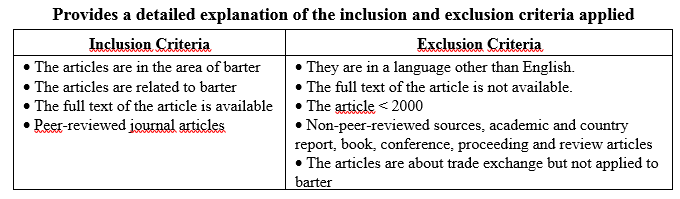
Identify relevant studies using the Patient, Intervention, Comparison, Outcome, and study design (PICOS) framework. The population included market barter, while the intervention assessed was sustainability. No direct comparison was included as the focus was solely on barter markets. Outcomes analyzed comprised concept sustainability and technology. The selection of literature was also based on set inclusion and exclusion criteria as shown in Table 1. Articles were included based on criteria that ensured their relevance to the research question. Conversely, exclusion criteria were established to remove the articles that fell outside the scope of this study.
Table 1
2.3. Search
In round two of this systematic review process, research articles relevant to barter were searched and compiled following specific search terms. Several sets of keywords were applied to gather research related to the Role of Barter Markets in Supporting Sustainability. The keyword string for search in the database is arranged as follows:
· Scopus – TITLE-ABS-KEY (‘Market Barter’ OR ‘Barter Exchange’ OR ‘Goods Exchange Market’ OR ‘Non-Monetary Market’ OR ‘Trade Exchange’)
· Web of Science – (‘Market Barter’ OR ‘Barter Exchange’ OR ‘Goods Exchange Market’ OR ‘Non-Monetary Market’ OR ‘Trade Exchange’) (Title)
The keywords above were obtained from the process flow in the Parsifal software. To conduct this in-depth literature search, various renowned journal databases were used. Selected databases were chosen due to their relevance and their availability via institutional accounts. Data Sources from Scopus (https://www.scopus.com) & Web of Science (https://www.webofscience.com).
2.4. Data Screening and Selection
Selected this set of sources because they are the most applicable and you can access them through your institutional accounts. Databases of literature were searched in December 2024 and the systematic review was conducted using Parsifal (https://parsif.al/), which was available as a comprehensive metadata screening facility to ensure transparency and consistency, following the recommended process proposed by the PRISMA guideline (Page et al. 2021). The first screening protocol involved identification of duplicates, and the second assessed eligibility based on previously determined inclusion and exclusion criteria. Eligible articles were those published in English between 2000 and 2024 that specifically addressed barter markets in supporting sustainability and in the area of barter. Non-peer-reviewed sources, academic and country reports, books, conference proceedings, and review articles were excluded from this analysis.
The screening process was conducted independently by all researchers. Only approved articles were included in this systematic review. The integrated tools of the platform systematically removed duplicates and applied inclusion and exclusion criteria. Titles and abstracts were assessed for relevance, and articles were classified as ‘accepted’ or ‘rejected.’ The selection process adhered to PRISMA guidelines (Page et al. 2021), with a flow diagram documenting the number of duplicates identified and articles accepted or rejected. Full-text versions of accepted articles were then retrieved for quality assessment.
2.5. Data Extraction
Data extraction (to extract all relevant information to be able to answer the research questions drawn above) was then performed at this stage. Data extraction involved the collection of relevant information and important aspects of the included review articles. The information extracted consisted of details on the specific barter examined in each article, and how it was used in support of sustainability. We also collected data on the research areas associated with each study, which enabled us to identify the most common approaches and themes across the literature we reviewed. Data extraction was performed in a systematic and rigorous manner based on predefined criteria, to guarantee consistency in information retrieval. Data were extracted in detail and analyzed to ensure that the correct data were collected relevant to the research outcome. This information was critical to addressing the proposed research questions and establishing a robust base for the analysis and synthesis of the reviewed literature, thus augmenting the empirical findings.
2.6. Quality assessment and data analysis
Subsequently,
articles underwent quality assessment by answering questions and evaluating
according to the Mixed Methods Appraisal Tools (MMAT) Version 2018 category of
study design qualitative (Hong et al. 2018). MMAT is a critical assessment tool designed for the
assessment stage of systematic qualitative study reviews. MMAT evaluates with five
methodological quality criteria. Each of the above criteria was assessed with:
(1) ‘Yes’ score 2; (2) ‘No’ score 1; (3) ‘Can’t tell’ score 0. Results scoring
below 5 indicate studies with low methodological quality not recommended for
further analysis. Data analysis was conducted using NVIVO 12 Plus software
(Lumivero, Denver, Colorado, USA). Coding was used to categorize content into
main research domains, allowing for a deeper understanding of patterns and
outcomes of sustainable barter markets. Thematic analysis was then applied to
the coded segments, facilitating the development of sub-codes within each
domain based on semantic similarities (Alinani
et al. 2020; Tumpa et al. 2022).
3. Results
3.1. Study Selection
The PRISMA flow diagram below illustrates the study selection process conducted in a systematic review or meta-analysis (Figure 1). This process began with the identification of records or articles from the Scopus database (618) and WOS (238), totaling 856 articles. Before the screening process, 162 duplicate articles were removed, leaving 694 unique articles to be screened. At the screening stage, 694 articles were reviewed; 634 articles not meeting the review criteria were excluded. The remaining 60 articles were then sought for eligibility checking by retrieving their full reports. All reports were successfully retrieved and screened for their eligibility against the inclusion and exclusion criteria of the review. At this point, we excluded 22 reports for quality control (QA) reasons. In total, 38 studies were included in this systematic review or meta-analysis. Figure 1 presents the PRISMA flowchart for study selection. This flowchart guides readers to comprehend the research process followed in the systematic review and evaluate the veracity and appropriateness of the findings.
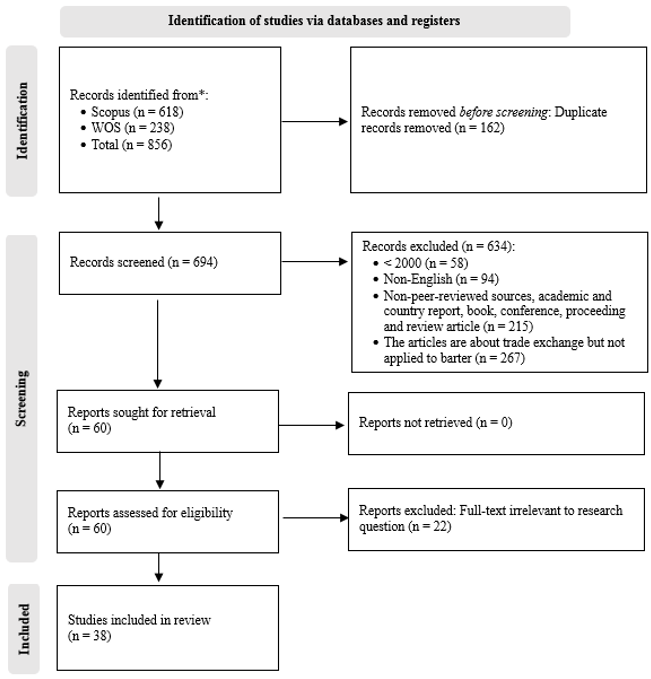
Fig 1. PRISMA flowchart
3.2. Barter Markets in Supporting Sustainability
Table 2 shows how barter system supports various sustainability aspects based on selected SLR articles. This table groups various sustainability aspects of barter system into three main categories: environmental sustainability, economic sustainability, and social sustainability. Barter markets make an important contribution to environmental sustainability through two main mechanisms. First, as demonstrated by Bieniek (2021), the barter system functions as an effective circular economy model due to its ability to reduce the impact of consumption by maximizing the utilization of existing assets and resources. Second, barter practices encourage the extension of product life cycles, which is crucial for environmental sustainability. Polukhina and Strelnikova (2015) emphasize that the reluctance to discard items is related to the desire to preserve the ‘life’ and history of these items, while reducing one's ecological footprint. This concept is very much in line with the principles of the circular economy that emphasize the reuse of resources and minimizing waste, which ultimately reduces pressure on the environment.
Table 2
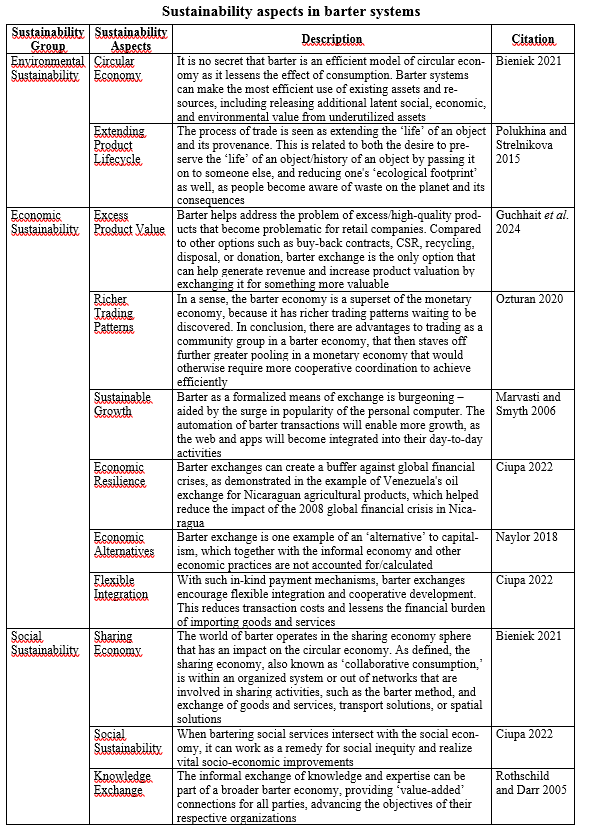
From an economic sustainability perspective, barter systems offer several significant advantages compared to conventional monetary economies (Anderson et al. 2017; Bieniek 2021; Ciupa 2022; Glorie et al. 2014; Guchhait et al. 2024; Gupta et al. 2019; Haddawy et al. 2005; Highley and Le 2018; Kannan et al. 2018; Koochaksaraei et al. 2024; Li et al. 2014; Marvasti and Smyth 2006; McGuire 2016; Michel 2002; Mishra et al. 2024; Nakajima and Gunji 2002; Owolabi et al. 2012; Ozturan 2020; Özturan 2004; Park and Rhee 2017; Shao 2009; Weber 2019). Guchhait et al. (2024) show that barter helps address the problem of excess products in a beneficial way, allowing companies to exchange products for something of higher value. Ozturan (2020) further characterizes the barter economy as a superset of the monetary economy that allows for richer and more complex trading patterns. The growth of organized barter supported by modern technology has improved the efficiency of these systems, as explained by Marvasti and Smyth (2006). Additionally, Ciupa (2022) demonstrates how barter exchanges can enhance economic resilience during crises, with a concrete example of how Nicaragua was able to mitigate the impact of the 2008 global financial crisis through barter exchanges with Venezuela.
Social sustainability is also strengthened through barter systems that encourage collaboration, sharing, and reduction of inequality (Bieniek 2021; Ciupa 2022; Lupo and Schmitt 2017; Naylor 2018; Polukhina and Strelnikova 2015; Rogers 2014; Rothschild and Darr 2005; Salignac et al. 2021; Savin 2021). Bieniek (2021) explains that barter is part of the ‘sharing economy’ or ‘collaborative consumption’ that occurs in organized systems where participants engage in sharing activities of various types of resources. Ciupa (2022) shows how the exchange of social services through barter can help reduce social inequality and achieve important socio-economic improvements. Rothschild and Darr (2005) extend this concept to the realm of knowledge, showing that informal exchanges of knowledge and expertise can be part of a broader barter economy that provides ‘value-added’ connections for all parties. This social dimension of barter enriches relationships between participants beyond mere economic value, building social capital that is important for long-term sustainability.
The most powerful aspect of barter systems is their ability to create integrated sustainability, which encompasses environmental, economic, and social dimensions simultaneously. Bieniek (2021) explicitly states that barter systems can support circular economies and economic, social, and environmental sustainability concurrently. This integration is crucial because effective sustainability approaches require balance between various dimensions, rather than focusing on just one aspect at the expense of others. Through barter mechanisms, product values can be maintained longer in the economic system, while simultaneously strengthening social bonds and reducing environmental impact. Barter systems thus offer a holistic sustainable model that can complement conventional economic systems in the transition toward a more sustainable society.
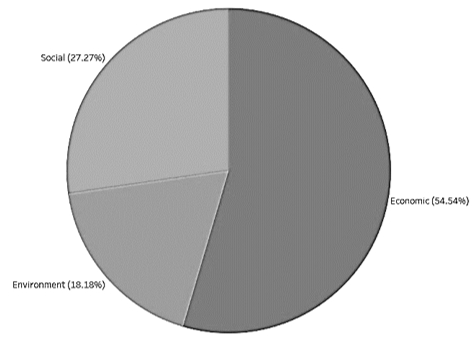
Fig. 2. Distribution of sustainability aspects in barter market systems
Figure 2 shows that barter brings the greatest benefits in the aspect of economic sustainability with a percentage of 54.54 %. The social aspect contributes 27.27 %, and the remaining portion is contributed by the environmental aspect at 18.18 %.
3.3. Digital Technology Integration in Barter Markets Supporting Sustainability
Table 3 shows how digital technologies support sustainable barter markets based on selected SLR articles. These technologies collectively overcome the traditional limitations of the barter system. By integrating these digital tools, barter markets can become a more viable alternative to traditional monetary transactions, supporting the principles of a circular economy and sustainability. The integration of digital technology into barter markets represents a significant advancement in addressing the limitations of traditional barter while promoting sustainability technologies (Anderson et al. 2017; Bieniek 2022; Cockfield 2015; Cowan and Jonard 2007; Haddawy et al. 2005; Highley and Le 2018; Kannan et al. 2018; Koochaksaraei et al. 2024; Mishra et al. 2024; Owolabi et al. 2012; Ozturan 2020; Özturan 2004; Urzicǎ et al. 2011). Online barter platforms function as digital marketplaces connecting individuals and businesses for exchanges without monetary transactions, which proved especially valuable during economic crises such as the COVID-19 pandemic (Bieniek 2021). These platforms extend product lifecycles, reduce waste generation, and enable the reuse of excess inventory that might otherwise be discarded, thereby supporting circular economy principles. The accessibility of these platforms allows participation from diverse economic backgrounds, creating new opportunities for those with limited financial resources but valuable goods or services to offer.
Table 3
Digital technologies for sustainable barter markets
|
Technology |
Description |
Sustainability |
Citation |
|
Online Barter Platforms |
Digital marketplaces that facilitate barter exchanges between individuals and businesses |
Extends product lifecycles, reduces waste, enables reuse of excess inventory |
Bieniek (2021): ‘Digital barter platforms, for example, iBarter, IMS Barter, b2b-barter, and barterxyz, can be useful during a crisis such as the one caused by COVID-19’ |
|
Blockchain Technology |
Distributed ledger technology that securely records ownership and transfers |
Ensures financial security, builds trust between trading partners, enables transparent tracking of goods |
Guchhait et al. (2024): ‘The recent development in blockchain fuels the barter trade exchange as it ensures high financial security of retail enterprise’ |
|
Social Networks |
Online communities that promote product exchange and sustainable consumption |
Connects users with similar interests, facilitates sharing economy practices |
Bieniek (2021): ‘Online social networks help spread the practice of product exchange, which is a trend of sustainable consumption’ |
|
Cloud-Based Barter Solutions |
Centralized systems that can match needs and offers efficiently |
Enables efficient matching of products and services, overcomes traditional barter limitations |
Bieniek (2022): ‘The emerging financial crisis may result in the rise of bartering via technological tools, for instance new cloud-based barter platforms’ |
|
B2B E-Marketplaces |
Internet-based transaction platforms for business-to-business exchanges |
Helps businesses move overstock inventory without monetary exchange |
Mishra et al. (2024): ‘Barter platform is an internet-based business-to-business (B2B) e-marketplace that gradually prospered over the last 20 years’ |
|
Optimization Algorithms |
Mathematical programming and AI for solving complex barter matching problems |
Maximizes exchange efficiency, solves coincidence of wants problem |
Haddawy et al. (2005): ‘Our optimization tool can help the trade brokers to optimize trade so that they can then concentrate on more human-oriented customer relation management issues’ |
|
Interactive Reputation Systems |
Trust-building mechanisms through feedback and user ratings |
Creates accountability, builds community trust, encourages fair exchanges |
Polukhina and Strelnikova (2015): ‘The most important tool of creating trust is the mechanism of interactive reputation… Comments help the community to generate feedback, which is necessary to keep the network working’ |
|
Centralized Exchange Software |
IT systems that coordinate and monitor business activities of members |
Solves the problem of coincidence of wants, enables non-simultaneous transactions |
Owolabi et al. (2012): ‘Barter trade has changed greatly in the last two decades with the advent of Information Technology (IT) which makes centralized exchange feasible’ |
|
Auction Systems |
Digital platforms that match supply and demand through bidding |
Validates quality of offered items, manages resource allocation efficiently |
Koochaksaraei et al. (2024): ‘The auctioneer carries out a validation operation. In this way, if a CSP falsely declares the quality status, the auctioneer will not allow it to participate’ |
|
AI-Powered Search Engines |
Advanced matching algorithms that find complementary wants |
Increases likelihood of finding multiple coincidences of wants quickly |
Ozturan (2020): ‘The likelihood of finding multiple coincidences of wants in smaller windows of time can be made higher by using AI-powered search engines’ |
Blockchain technology has emerged as a transformative force in barter markets by providing secure and transparent records of ownership and transfers. According to Guchhait et al. (2024), blockchain implementation enhances financial security for companies involved in barter exchanges, addressing traditional concerns about trust and verification in non-monetary transactions. This technology creates immutable records of exchanges, reducing disputes and increasing trust between trading partners who may not have prior relationships. Although blockchain offers strong economic benefits and trust-building advantages, its environmental impact due to energy consumption remains a consideration that must be balanced against its sustainability benefits in extending product lifecycles and reducing waste.
Social networking and cloud-based barter solutions offer complementary approaches to facilitating sustainable exchange practices. Online social networks help disseminate product exchange practices as a sustainable consumption trend (Bieniek 2021), leveraging existing community connections to promote sharing economy principles. These platforms build social capital to create trust among users, making exchanges more likely to occur and succeed. Meanwhile, cloud-based barter platforms provide the technological infrastructure to efficiently match needs and offerings, with Bieniek (2022) noting that ‘emerging financial crises can result in the emergence of barter through technological tools, for example, new cloud-based barter platforms.’ Together, these technologies create accessible pathways for individuals and businesses to participate in the circular economy.
Business-focused technologies such as B2B e-marketplaces and optimization algorithms address the specific needs of commercial barter exchanges. B2B barter platforms have demonstrated remarkable growth, with Mishra et al. (2024) reporting that ‘more than 50,000 companies engage in barter business to move their excess inventory.’ These platforms create significant economic value by helping businesses manage surplus inventory without monetary transactions, reducing waste from unsold products. Optimization algorithms complement these platforms by efficiently solving the ‘coincidence of wants’ problem that has historically limited barter transactions. Haddawy et al. (2005) note that as barter pools grow in size and complexity, ‘it becomes impossible for human trade brokers to find optimal matches between sellers and buyers,’ making algorithmic solutions essential for maximizing exchange efficiency.
Trust-building technologies such as interactive reputation systems address the social dimension of sustainable barter markets. Polukhina and Strelnikova (2015) identify user feedback mechanisms as the ‘most important tool for creating trust’ in online exchange communities, enabling participants to identify reliable trading partners. These systems create accountability through public ratings and comments, encouraging fair and honest exchanges that build community trust over time. Combined with centralized exchange software that coordinates and monitors member activities (Owolabi et al. 2012), these technologies create a framework for barter exchanges that can operate efficiently across geographical boundaries and between participants with no prior relationships, greatly expanding the potential scale and impact of barter markets.
Advanced matching technologies such as auction systems and AI-powered search engines represent the cutting edge of sustainable barter market development. Auction systems provide validation of the quality of offered goods and efficient matching between supply and demand (Koochaksaraei et al. 2024), creating trust in the exchange process. AI-powered search engines further enhance matching efficiency, with Ozturan (2020) noting that ‘the possibility of finding multiple coincidences of wants in a smaller time window can be made higher using AI-powered search engines.’ These technologies directly address the fundamental challenge limiting traditional barter – finding trading partners with complementary needs and offerings – enabling transactions that would be impossible to coordinate manually. Their ability to facilitate complex multi-party exchanges significantly expands the potential scale and impact of barter as an alternative to traditional monetary transactions.
3.4. The Effectiveness of Technology on Barter Markets in Supporting Sustainability
Table 4 Assessment of digital technology effectiveness in supporting barter market sustainability, indicates that while most technologies have strong economic benefits, their social and environmental impacts vary significantly. Online Barter Platforms, Social Networks, and B2B E-Marketplaces appear to have the most balanced sustainability profiles across all three dimensions. Blockchain technology scores well economically but faces environmental challenges due to energy consumption concerns. Interactive Reputation Systems excel in social sustainability but have less direct environmental impact. For a comprehensive sustainable barter system, combining multiple technologies with complementary sustainability profiles would likely yield the best results. The authors evaluate each technology using sustainability indicators (Economic, Social, and Environmental) on a scale of 1–5, where: 1 = Very Low Impact; 2 = Low Impact; 3 = Medium Impact; 4 = High Impact; 5 = Very High Impact, for assessment of digital technology effectiveness in supporting barter market sustainability.
Table 4
Assessment of digital technology
effectiveness
in supporting barter market sustainability
|
Technology |
Sustainability Indicator |
Value (1–5) |
Justification |
|
Online Barter Platforms |
Economic |
5 |
Creates significant economic value by enabling transactions without currency, particularly valuable during financial crises |
|
Social |
4 |
Builds community connections and enables access to goods/services for those with limited financial resources |
|
|
Environmental |
4 |
Extends product lifecycles and reduces need for new production |
|
|
Blockchain Technology |
Economic |
4 |
Increases financial security and enhances valuation of exchanged goods |
|
Social |
3 |
Builds trust between parties but has limited direct social benefits |
|
|
Environmental |
2 |
Energy consumption concerns may offset sustainability benefits |
Table 4 (continued)
|
Social Networks |
Economic |
3 |
Facilitates exchanges but with less direct economic impact than dedicated platforms |
|
Social |
5 |
Creates strong community bonds and promotes sharing economy values |
|
|
Environmental |
4 |
Encourages product reuse and sustainable consumption patterns |
|
|
Cloud-Based Barter Solutions |
Economic |
4 |
Efficiently matches supply and demand, creating economic value |
|
Social |
3 |
Moderate social impact through facilitation of exchanges |
|
|
Environmental |
3 |
Reduces waste but has energy consumption from cloud infrastructure |
|
|
B2B |
Economic |
5 |
Significant economic impact by helping businesses move overstock inventory |
|
Social |
2 |
Limited social benefits as primarily focused on business transactions |
|
|
Environmental |
4 |
Reduces waste from excess inventory that might otherwise be discarded |
|
|
Optimiza- |
Economic |
5 |
Maximizes exchange efficiency and solves the coincidence of wants problem |
|
Social |
2 |
Limited direct social benefits |
|
|
Environmental |
3 |
Indirectly supports sustainability through more efficient resource allocation |
|
|
Interactive Reputation Systems |
Economic |
3 |
Improves market function but indirect economic impact |
|
Social |
5 |
Builds community trust and accountability |
|
|
Environmental |
2 |
Limited direct environmental impact |
|
|
Centralized Exchange Software |
Economic |
4 |
Solves fundamental barter problems, enabling more transactions |
|
Social |
3 |
Facilitates community exchanges |
|
|
Environmental |
3 |
Moderately reduces waste through better matching |
|
|
Auction Systems |
Economic |
4 |
Efficient resource allocation and quality validation |
|
Social |
2 |
Limited social benefits |
|
|
Environmental |
3 |
Moderate environmental benefits through improved resource allocation |
|
|
AI-Powered Search Engines |
Economic |
4 |
Quickly finds multiple coincidences of wants, increasing transaction volume |
|
Social |
3 |
Moderately improves accessibility of barter systems |
|
|
Environmental |
4 |
Contributes to circular economy by facilitating more exchanges |
Based on sustainability assessments, online barter platforms demonstrate the best overall performance with high scores across all sustainability dimensions. These platforms receive the highest score (5) for economic sustainability due to their ability to create significant economic value through currency-free transactions, which is particularly valuable during financial crises. In the social dimension, these platforms earn a score of 4 due to their effectiveness in building community connections and providing access to goods and services for those with limited financial resources. From an environmental perspective, these platforms also receive a score of 4 for their positive contribution to extending product lifecycles and reducing the need for new production, aligning with circular economy principles that emphasize the reuse of existing resources.
Blockchain technology exhibits a different value pattern, emphasizing economic advantages but having environmental limitations. With a score of 4 for the economic dimension, blockchain effectively enhances financial security and strengthens the valuation of exchanged goods through transparent and immutable transaction records. Its social score is moderate (3) because, although it builds trust between parties, this technology has limited direct social benefits compared to platforms that actively build communities. The primary weakness of blockchain lies in the environmental dimension with a low score (2), reflecting concerns about high energy consumption that may offset other sustainability benefits. This indicates that while blockchain offers a robust technological solution for trust issues in barter exchanges, its implementation must consider its environmental impact.
Social networks and B2B marketplaces demonstrate interesting complementary strengths in supporting barter sustainability. Social networks excel in the social dimension with a perfect score (5) due to their ability to create strong community bonds and promote sharing economy values that foster social cohesion. Meanwhile, B2B marketplaces dominate in the economic (5) and environmental (4) dimensions because of their effectiveness in helping businesses manage excess inventory, which reduces waste and creates new economic value. These differing profiles suggest that combining both technologies could create a more comprehensive barter system, with social networks providing social infrastructure and trust, while B2B marketplaces optimize economic efficiency and waste reduction on a larger scale.
Optimization algorithms and auction systems represent technologies that are highly oriented toward economic efficiency with more limited social impact. Optimization algorithms achieve the highest score (5) for economic sustainability due to their ability to solve the ‘coincidence of wants’ problem that has historically limited barter, enabling more transactions to occur. However, both technologies receive low social scores (2) because of their focus on technical efficiency rather than community building or trust. Their environmental scores are moderate (3) because, although they support sustainability through more efficient resource allocation, their direct impact is limited. This profile suggests that these technologies are best used as supporting components in broader barter systems that also incorporate elements of trust and community building.
Interactive reputation systems stand out as technologies with the highest social value (5) but with limited environmental impact. These systems are highly effective in building community trust and accountability through feedback mechanisms and ratings, addressing trust issues that often limit barter exchanges between unfamiliar parties. Their moderate economic score (3) reflects their supporting role in improving market function, although their economic impact is more indirect compared to actual trading platforms. Their low environmental score (2) indicates their limited influence on environmental sustainability, as these technologies focus more on the social aspects of exchange. This profile confirms that reputation systems play a crucial role in the social infrastructure of digital barter but need to be complemented by other technologies that more directly support environmental and economic objectives.
AI-powered search engines show a balanced sustainability profile with strong scores across multiple dimensions. These technologies receive high scores for economic sustainability (4) due to their ability to quickly find matches for multiple coincidences of wants, increasing the volume of potential transactions. Their social score is moderate (3) because they improve the accessibility of barter systems although they do not directly build social bonds. Surprisingly, their environmental score is also high (4) due to their contribution to the circular economy by facilitating more exchanges that extend product lifecycles. This relatively balanced profile indicates that AI search engines can be an important component in comprehensive digital barter systems that support sustainability across all dimensions, especially when combined with technologies that strengthen social aspects such as interactive reputation systems.
The overall assessment of the ten technologies shows that no single solution excels in all sustainability dimensions, emphasizing the importance of an integrated approach. Online barter platforms, social networks, and B2B marketplaces have the most balanced sustainability profiles across all three dimensions, while other technologies show strengths in specific areas. The most effective approach to supporting sustainable barter markets likely involves a combination of complementary technologies, with each technology addressing different aspects of sustainability. For example, blockchain and optimization algorithms can provide robust economic infrastructure, interactive reputation systems build social trust, while online barter platforms and B2B marketplaces connect economic, social, and environmental aspects. The development of such an integrated technology ecosystem could significantly enhance the contribution of barter to sustainability goals across all dimensions.
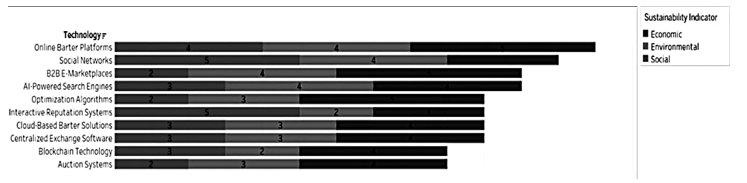
Fig. 3. Assessment of Digital Technologies for Sustainable Barter Markets
The visualization in Figure 3 confirms that no single technology excels in all di-mensions of desirability, indicating the need for an integrated approach that combines multiple technologies with complementary strengths to comprehensively support barter market desirability.
3.7. Understand the Causes of the Development of Barter
Table 5 categorizes and documents these primary causes based on empirical findings from various academic studies, revealing a fascinating phenomenon in contemporary economics: how barter systems, once considered primitive exchange mechanisms, now experience a renaissance driven by the convergence of four interconnected and mutually reinforcing factors. Economic factors serve as the primary catalyst driving the revival of modern barter. When examining quotations from empirical research, it becomes clear that barter is not a randomly emerging phenomenon, but rather a rational response to instability in the conventional economic system. As explained by Marvasti and Smyth (2006), ‘domestic barter is likely to flourish during economic downturns as companies attempt to reduce excess business inventories through barter transactions.’ This observation reveals a consistent pattern: when monetary systems experience pressure, economic actors tend to revert to more fundamental exchange mechanisms. The 2008 global financial crisis provided strong empirical evidence for this phenomenon. As documented by Owolabi et al. (2012), the crisis highlighted the devastating consequences of excessive dependence on complex financial systems. In this context, barter emerges as an economic ‘safety net’ that does not depend on currency stability or banking systems. More interestingly, the COVID-19 pandemic showed that even in highly integrated modern economies, small businesses can experience severe liquidity crises in short periods, with median companies having monthly expenses over $10,000 possessing only enough cash to survive for two weeks.
Table 5
Causes of Barter Development
|
Causal Factor |
Cause |
Description |
Citation |
|
Economic Factors |
Economic Crisis and Monetary Instability – Barter flourishes during economic crises, inflation, and currency instability |
‘Domestic barter is likely to flourish during economic downturns as companies attempt to reduce excess business inventories though barter transactions’ (Marvasti and Smyth 2006); ‘The August 2007, Global Financial Crisis is yet another blow on the world monetary system’ (Owolabi et al. 2012); ‘Devaluation and inflation problems in countries like Argentina and Turkey make it difficult for people to trade goods by using their fragile currency’ (Özturan 2004); ‘examined 5800 small businesses in the beginning of Covid-19 outbreak and stated that: “The median firm with monthly expenses over $10,000 had only enough cash on hand to last roughly 2 wk [weeks]”’ (Bieniek 2022) |
Bieniek 2022; Marvasti and Smyth 2006; Owolabi |
|
Excess Inventory Management – Companies use barter to address surplus stock and unsold inventory |
‘Barter exchange, as an alternative to move distressed inventory, has become increasingly popular in business’ (Hua et al. 2020); ‘Nowadays, barter exchange has become growingly popular in the national and global industries as an alternative to excessive inventory transfers’ (Mishra et al. 2024); ‘Recently, especially at a time of crisis, such as during the COVID-19 pandemic, firms have increasingly moved their excess or obsolete inventory to barter platforms’ (Bieniek 2021); ‘The unexpected business inventory accumulation stimulates barter’ (Marvasti and Smyth 2006) |
Bieniek 2021; Hua et
al. 2020; Marvasti and Smyth 2006; Mishra |
|
|
Cash Liquidity Preservation – Barter enables companies to obtain needed goods without cash expenditure |
‘Using barter, a firm can buy the product it needs without money, which helps preserve valuable liquidity’ (Hua et al. 2020); ‘Bartering provides member businesses with a cashless alternative that reduces bad debts, converts surplus stock into profits, and mitigates cash expenditures’ (Bieniek 2021); ‘But businesses and consumers may have good reasons to engage in barter even in the absence of tax evasion. Businesses may prefer to receive payment in kind if the bartered goods or services received contribute unique value to their ongoing operations’ (Cockfield 2015) |
Bieniek 2021; Cockfield 2015; Hua et al. 2020 |
|
|
Avoiding Transaction Costs and Price Uncertainty – Barter reduces additional transaction costs and inflationary uncertainty |
‘Barter exchange promoted flexible integration and cooperative development by allowing countries to pay for goods and services in kind. This avoided extra transaction costs and eased the financial burden of importing goods and services’ (Ciupa 2022); ‘To avoid being subject to price increases and uncertainties associated with trade under inflationary conditions, interest in barter is also likely to increase during inflationary periods’ (Marvasti and Smyth 2001); ‘One of the challenges of currency-based models is spending a lot of time participating in auctions... In such models, money must be paid for renting resources’ (Koochaksaraei et al. 2024) |
Ciupa 2022; Koochak- |
|
|
Finding New Customers and Market Development – Barter helps small businesses discover new customers and develop markets |
‘In a slow economy, a barter system can help small businesses to find
new customers and move their inventory, which supports the circular economy’ (Bieniek
2021); |
Bieniek 2021; Hua et al. 2020 |
|
|
Alternative to Trade Credit – Barter functions as a complement or alternative to credit systems in trade |
‘In addition to clearing excess inventories, barter can be an important complement to trade credits. The trade credit is a remarkable tool to boost market demand by attracting more customers’ (Bieniek 2022); ‘Barter does not necessarily require immediate exchange and can entail a system of credit and debit that obligates the future production of one or both parties’ (Lupo and Schmitt 2017) |
Bieniek 2022;
|
|
|
Environmental Factors |
Sustainability, and Circular Econo- |
‘In a slow economy, a barter system can help small businesses to find
new customers and move their inventory, which supports the circular economy.
Old-fashioned barter exchange has an exceptional power to attract new
customers and sell excess inventory’ (Bieniek 2021); |
Bieniek 2021; Mishra
|
|
Waste and Excess Stock Management – Barter helps reduce the risk of wasteful disposal of excess stock, which wastes carbon and energy |
‘This approach supports sustainability goals, that is, reduces the risk of wasteful stock disposal, because excess inventory wastes carbon and energy’ (Bieniek 2021) |
Bieniek 2021 |
|
|
Maximum Resource Utilizati- |
‘Barter provides the ability to unlock the untapped social, economic, and environmental value of assets which may not have been fully exploited. It also helps maximize existing resources, that is, vehicles not being parked and left unused, and food not going to waste’ (Bieniek 2021) |
Bieniek 2021 |
|
|
COVID-19 Pandemic – The pandemic crisis drives companies to move excess inventory to barter platforms |
‘Recently, especially at a time of crisis, such as during the COVID-19 pandemic, firms have increasingly moved their excess or obsolete inventory to barter platforms, including traditional and digital barter platforms’ (Bieniek 2021); ‘Barter exchange has been growing in popularity during the coronavirus pandemic’ (Bieniek 2022) |
Bieniek 2021, 2022 |
|
|
Natural Resource Scarcity – Commodity scarcity drives traditional barter practices to maintain access to resources |
‘Meat is also a valued resource central to traditional barter exchange. Ethnographic research often cites prey scarcity and commodification as two factors reducing traditional meat transactions among indigenous Central African foragers’ (Lupo and Schmitt 2017); ‘In 2008, however, these dynamics were further complicated by a local drought and by the worldwide spike in food commodity prices, which together threw household budgets into even greater disarray and combined to drive the price of sheep to unpredictable lows’ (McGuire 2016) |
Lupo and Schmitt 2017; McGuire 2016 |
|
|
Social Factors |
Maintaining Social
Relationships – Barter is used |
‘Further evidence of the desire to maintain
relationships with farmers is reflected by the use of income derived from
forest commodities... foragers rarely used money |
Lupo and Schmitt 2017; Polu- |
|
Group Solidarity and Social Assistance – Barter emerge in situations that encourage group solidarity and mutual assistance |
‘Seeking items for a 5 year old boy as a gift ... he’s a son of our concierge, we are neighbors, and I always see him wearing the same clothes... I’m a single mother, my husband has left and I need clothes for my children’ (Polukhina and Strelnikova 2015); ‘The Stable Barter problem can model scenarios where transactions eschew financial exchanges for goods/services, the most obvious ones being those where there is a humanitarian or altruistic consideration at stake’ (Gupta et al. 2019) |
Gupta |
|
|
Knowledge Exchange and Informal Networks – Knowledge barter in informal networks among professionals and researchers |
‘Many authors have shown empirically that knowledge is traded extensively over informal networks of contacts... When competitors are involved, though, this is often quid pro quo: exchange is not a gift but a barter’ (Cowan and Jonard 2007); ‘Von-Hipple discusses at length the concept of know-how trading in informal networks of engineers... Once information is provided, the engineer on the receiving side realizes that he/she will be asked to reciprocate at a future date’ (Rothschild and Darr 2005); ‘knowledge can be shared under stricter and more formal rules where agents are ready to share knowledge only if they get something in return (for example, by means of the barter exchange mechanism)’ (Savin 2021) |
Cowan and Jonard, 2007;
Roths- |
|
|
Anti-Monetary Ideology – Ideological views toward money use drive preference for barter |
‘The persistence of barter is also due to long-standing ideological views among foragers about the use of money. Most foragers we interviewed in Grima and Ndele only used money to purchase needed commodities if they could not be obtained by barter’ (Lupo and Schmitt 2017) |
Lupo and Schmitt 2017 |
|
|
Exchange Based on Non-Economic Values – Barter is based on values that transcend fixed prices and humanitarian considerations |
‘The persistence of barter exchange in rural communities is complex and partly linked to the longstanding tradition of barter throughout Africa that is based on values that transcend fixed prices’ (Lupo and Schmitt 2017); ‘In addition to kidney exchange, and organ donation in general, there are more traditional objects that are transacted in a similar non-monetary fashion. For example, we can point to vacation rentals, books, shoes as tradable objects’ (Gupta et al. 2019) |
Gupta |
|
|
Extending Product Lifecycle – Barter as a way to extend the ‘life’ of goods and preserve their history |
‘Also the ‘gifts’ are accepted as a way to prolonging items life. The reluctance to dispose an item it is associated with the need to preserve its ‘life’ and its history. By giving items to others, they act as a key element of ‘multiple’ consumption in terms of esthetic, memorable and economic value’ (Polukhina and Strelnikova 2015) |
Polukhi-
|
|
|
Technological Factors |
Digital Platforms and Blockchain – Blockchain technology and digital platforms facilitate the recording and verification of ownership in barter exchanges |
‘We now have blockchain infrastructures that allow us to keep records
of ownership of items and transfer them in |
Guchhait et al. 2024; Ozturan 2020 |
|
Optimization Algorithms and AI – Modern optimization software and AI can solve ‘double coincidence of wants’ problems at scale |
‘There are fast optimization software packages (minimum cost flow solvers and integer programming solvers) that can give solutions to double (or multiple) coincidence of wants problems involving large number of people and items... the likelihood of finding multiple coincidences of wants in smaller windows of time can be made higher by using AI-powered search engines’ (Ozturan 2020) |
Ozturan 2020 |
|
|
Cybersecurity and Cryptocurrency – Cybersecurity problems in monetary systems drive the adoption of barter with cryptocurrency |
‘Due to the cyber security problem, the retail industry must need a substitute to save their money from the stolen events. Using cryptocurrency, the whole retail management can get many more benefits rather than paper money’ (Guchhait et al. 2024) |
Guchhait et al. 2024 |
|
|
Online Exchange Platforms – The Internet enables the emergence of online barter platforms connecting parties seeking to exchange |
‘I have reason to believe, however, that bartering will be popular again in the modern society... It is possible that the Internet, which popularized auction exchanges, can also trigger resurrection of bartering on a massive scale’ (Özturan 2004); ‘A number of startups such as ‘TradeYa’ and ‘BarterQuest’ act as market makers for barter exchange of consumer goods’ (Kannan et al. 2018) |
Kannan
|
|
|
Exchange Process Automation – Technology enables automation in matching needs and offers in barter |
‘The proposed model does not involve monetary barter between participants. This makes them more motivated to participate in the auction. In addition, CSPs do not suffer from SLA violations because they have not paid’ (Koochaksaraei et al. 2024) |
Koochak-saraei et al. 2024
|
However, the revival of modern barter would not be possible without the technological revolution that provides the necessary infrastructure. Here we see how technology functions not merely as a tool but as a transformative ‘enabler’ that overcomes the fundamental limitations of traditional barter systems. The analogy presented by Özturan (2004) is highly illustrative: blockchain can be viewed as ‘an open square where the prehistoric person put forward all the items they owned and wanted to trade,’ but with the capability to operate globally without requiring interpersonal trust. This technology addresses three fundamental problems that have long limited the effectiveness of barter. First, the trust problem is resolved through the blockchain's ‘trustless’ system, which enables ownership verification and asset transfer without requiring third parties. Second, the ‘double coincidence of wants’ problem – where both parties must mutually need what the other offers – is solved through sophisticated optimization algorithms that can identify multi-party exchange chains within seconds. Third, the scale problem is resolved through digital platforms that can connect millions of users worldwide.
Environmental factors add moral and ethical dimensions, providing social legitimacy for modern barter practices. In an era where sustainability becomes a global imperative, barter offers an elegant solution to resource waste problems. As explained by Bieniek (2022), ‘this approach supports sustainability goals, that is, reduces the risk of wasteful stock disposal, because excess inventory wastes carbon and energy.’ This statement highlights how modern barter has evolved from a mere economic mechanism to a tool for environmental sustainability. The COVID-19 pandemic accelerated this awareness when companies worldwide faced massive inventory surpluses. Instead of disposing of these products in landfills, which would contribute to environmental damage, companies increasingly turn to barter platforms to give products a ‘second life.’ This phenomenon reflects a paradigm shift from a linear economy (‘take-make-dispose’) toward a circular economy, emphasizing reuse and resource optimization.
Most interesting from this analysis is how social factors reveal the humanistic dimension of barter, which is often overlooked in conventional economic analysis. Anthropological research conducted by Lupo ana Schmitt (2017) shows that ‘the persistence of barter exchange in rural communities is complex and partly linked to the longstanding tradition of barter throughout Africa that is based on values that transcend fixed prices.’ This observation reveals that barter is not only about economic efficiency but also about maintaining social relations and community values. In modern contexts, this social dimension remains relevant but takes different forms. Research by Polukhina and Strelnikova (2015) reveals how digital exchange platforms create virtual communities where people not only exchange goods but also share stories, build solidarity, and extend the ‘life’ of objects with sentimental value. This phenomenon demonstrates that, although technology has changed the medium of exchange, basic human motivations for sharing and building social connections remain unchanged.
Most significant from these results is the understanding that these four factors do not operate independently but form a synergistic and self-reinforcing system. Economic crises drive technological innovation, which enables the implementation of sustainable solutions, and digital platforms facilitate the formation of social communities that, in turn, strengthen the legitimacy and adoption of barter systems. This interaction pattern indicates that the modern barter revival is not a temporary or marginal phenomenon, but rather a structural transformation reflecting a fundamental evolution in how humans organize their economy. When considering future projections, it becomes evident that digital barter has the potential to become an integral component of the global economy, particularly in the context of the transition toward a more sustainable and inclusive economy.
4. Discussion
This research examines the important role of applying sustainability concepts in the context of barter markets, explores digital technology support for barter market sustainability, and provides effective technological solutions for sustainable barter markets. Based on a systematic review of 38 articles meeting the inclusion criteria, the main findings show that barter markets play a significant role in supporting sustainability through three key dimensions: environmental, economic, and social.
In the environmental dimension, barter systems have proven to function as an effective circular economy model by maximizing the utilization of existing assets and resources. Barter practices also encourage the extension of product life cycles by giving ‘new life’ to goods that might otherwise be discarded, thus reducing consumers' ecological footprint. These findings confirm that barter markets can be an effective strategy to address the problems of overconsumption and resource waste that characterize conventional linear economies.
From an economic perspective, barter markets offer significant advantages compared to traditional monetary economies. Barter systems help address surplus product issues in beneficial ways, enable richer and more complex trading patterns, and enhance economic resilience during crises. These findings align with the research objective of understanding how barter markets can serve as alternative exchange systems that support sustainable development. In the social dimension, barter markets encourage collaboration, sharing, and reduction of inequality. Research results indicate that barter is part of the ‘sharing economy’ that promotes collaborative consumption, helps reduce social inequalities, and facilitates informal knowledge exchange that provides added value for all parties. These findings strengthen our understanding of the potential of barter markets to create more inclusive and equitable exchange models. The most important aspect of barter systems revealed in this research is their ability to create integrated sustainability that simultaneously encompasses environmental, economic, and social dimensions. This aligns with the research objective of developing a more sustainable barter market model integrated with digital technology as an alternative exchange system that supports sustainable development.
This systematic review also identified ten key digital technologies that play important roles in supporting barter market sustainability. Online barter platforms showed the best overall performance with high scores across all sustainability dimensions, especially in creating significant economic value through currency-free transactions. Blockchain technology enhances financial security and strengthens the valuation of exchanged goods, although its environmental impact requires attention due to high energy consumption. Social networks and B2B marketplaces demonstrate complementary strengths in supporting barter sustainability, with social networks excelling in the social dimension and B2B marketplaces dominating in economic and environmental dimensions. Optimization algorithms and auction systems represent technologies oriented toward economic efficiency, solving the ‘coincidence of wants’ problem that has historically limited barter. Interactive reputation systems stand out in building community trust and accountability, while AI-powered search engines demonstrate a balanced sustainability profile with their ability to quickly find matches for multiple coincidence of wants. These findings suggest that an integrated approach combining various complementary technologies can significantly enhance the contribution of barter to sustainability goals across all dimensions.
The analysis of factors causing barter development reveals four main categories: economic, environmental, social, and technological. Economic crises and monetary instability emerge as primary catalysts, reinforced by the need for effective inventory management and preservation of cash liquidity. The COVID-19 pandemic accelerated the adoption of digital barter, demonstrating how crises can drive innovation in exchange systems. These findings not only answer the fourth research question but also reveal the dynamic and adaptive nature of barter systems in responding to contemporary challenges.
The findings of this research largely align with previous literature indicating that barter can play an important role in various economic contexts, such as reducing waiting times and increasing exchange efficiency, becoming an alternative to black markets in crisis situations, reducing capital pressure and increasing profits in limited supply chains, and facilitating the exchange of second-hand goods for a circular economy. However, this research also identified several important differences compared to previous studies. For example, this research found the relatively low environmental impact of blockchain technology in the context of barter markets due to high energy consumption, which differs from the optimistic views of some previous research on this technology. Additionally, although some previous research emphasized technical constraints in implementing large-scale barter systems, these findings indicate that modern technologies such as AI and optimization algorithms have overcome most of these constraints.
This research provides several significant new contributions. First, a comprehensive evaluation framework was developed to assess the effectiveness of digital technologies in supporting barter market sustainability based on three dimensions: economic, social, and environmental. This framework can be a valuable tool for researchers and practitioners to evaluate future barter initiatives. Second, this research combines perspectives from various disciplines for a holistic understanding of the role of barter markets in supporting sustainability. This interdisciplinary approach enriches existing literature by emphasizing the integration of sustainability dimensions in barter systems. Third, the optimal combination of technologies to support sustainable barter-markets is identified, providing practical guidance for the development of future barter platforms. These findings fill gaps in the literature on technology implementation in sustainable barter markets.
The findings of this research have significant implications for the development of theory, practice, and policy. In terms of theory, these findings contribute to the development of circular economy theory, social exchange theory, and innovation diffusion theory in the context of barter markets and digital technology. The development of circular economy theory is advanced by demonstrating how barter systems can become effective mechanisms for maximizing asset utility and extending product life cycles. These results expand the theoretical understanding of circular economy beyond conventional business models and recycling practices. The development of social exchange theory is enhanced by identifying how digital technology can facilitate the formation of trust and social norms in exchanges without using currency. These findings enrich the understanding of social dynamics in sharing economies and collaborative consumption. The development of innovation diffusion theory is advanced by demonstrating how digital technology can overcome traditional barriers in the adoption of barter practices on a broader scale. The proposed technology integration model can serve as a theoretical framework for understanding innovation adoption in alternative economic systems.
In practical terms, these findings provide guidance for barter platform developers, business actors, and organizations focused on sustainable consumption to select optimal technology combinations in supporting sustainability goals. For SMEs, there is potential for barter as a strategy to manage excess inventory and create economic value without mo-netary transactions. B2B barter platforms and cloud-based solutions can help businesses optimize their resource usage and reduce waste. For organizations and communities focused on sustainability, social networks and online barter platforms can facilitate the exchange of used goods and promote sharing economies. Interactive reputation systems can help build trust in these exchanges, encouraging wider participation.
For policymakers, this research highlights the importance of creating regulatory frameworks that support the development of barter markets as alternatives to sustainable exchange systems. Tax and accounting policies that accommodate barter transactions can encourage broader adoption of these practices. Findings about economic resilience through barter exchanges during crises indicate that policymakers should consider the role of barter markets in national and local economic resilience strategies. Support programs for the development of barter platforms, especially those utilizing digital technology, can be part of sustainable development strategies. Policies that encourage the development of energy-efficient digital infrastructure are also necessary to ensure that technologies such as blockchain can support barter markets without causing significant environmental impacts. Investment in research and development of sustainable barter technologies should be a priority in the innovation policy agenda.
One unexpected finding in this research was the dominance of economic sustainability aspects (54.54 %) compared to social (27.27 %) and environmental (18.18 %) aspects in barter systems. Although barter is often associated with environmental benefits, these findings indicate that economic benefits remain the primary driver for the adoption of barter practices. A potential explanation for this finding is that in the context of modern economies, market participants still prioritize economic value in decision-making, and environmental and social benefits are considered additional positive impacts rather than primary objectives. Another unexpected finding was the relatively low environmental value for blockchain technology (2 out of 5) despite its great potential in supporting barter markets. This may be due to the high energy consumption in current blockchain implementations, indicating the need for further development of more energy-efficient blockchain technology to improve its environmental sustainability. Additionally, it is interesting that AI-powered search engines have a high environmental value (4 out of 5), which might be unexpected given common concerns about AI energy consumption. A potential explanation for this is that the benefits from increased efficiency in finding exchange matches outweigh the energy costs of operating AI, resulting in a net reduction in waste and resource usage. The significant role of the COVID-19 pandemic in accelerating digital barter adoption is also surprising, highlighting how crises can serve as catalysts for transforming the economic system. This phenomenon reveals the inherent resilience and adaptability of barter systems that enable them to thrive precisely when conventional economic systems experience pressure. These findings suggest that barter may have a larger role than previously anticipated in building economic resilience against future crises.
As an example the modern barter system ‘Barter for a Better Fiji’ (BFBF) (Finau and Kant 2022) achieved extraordinary success measurable through exponential user adoption from zero to 186,988 members (21 % of Fiji's population) within weeks, activity volume of thousands of daily posts, and model replication in other Pacific nations with international media coverage. This success resulted from the convergence of ideal factors: severe economic crisis where 115,000 people (33 % of workforce) were affected by tourism sector collapse contributing 40 % of GDP, familiar Facebook digital infrastructure, strong Indigenous Fijian cultural foundation with traditional value systems such as veisa, kerekere, and veisolevuti, and effective governance structure with non-cash only rules and community policing. The platform successfully created local economic transformation through non-monetary systems connecting producers directly with consumers without intermediaries, providing access to goods and services for the unemployed, optimizing surplus and skills monetization, while building social capital through traditional kinship network reactivation, restoration of traditional veitauvu relationships, and creation of community-based reputation systems demonstrating how ‘old ways and new means’ can create sustainable alternative economies.
The systematic review used in this research has several significant methodological strengths, such as rigorous protocols for transparency and reproducibility, the use of multiple databases for comprehensiveness, specialized software for analytical precision, and inclusion/exclusion criteria and quality assessment to enhance the reliability of findings. However, this research also has several limitations, such as only covering English language articles, excluding non-Scopus and WOS academic information sources, a relatively small number of articles, and subjectivity in the assessment of technology effectiveness.
Although this research provides a comprehensive understanding of the role of barter markets in supporting sustainability, there are still gaps, and several important knowledge gaps still need to be filled through future research. Promising gap areas for further exploration include:
1. Empirical studies on the relative impact of various digital technologies on sustainability outcomes in barter contexts;
2. Investigations of contextual factors (e.g., culture, policy, infrastructure) that influence the success of barter initiatives;
3. Development of evaluative frameworks to assess the sustainability of barter markets;
4. Exploration of the potential integration of barter with conventional economic systems.
Addressing these gaps will advance our understanding of barter as a tool for sustainability and inform the development of more effective and context-specific barter solutions. More empirical studies are needed on the real impact of various digital technologies on the sustainability of barter markets, in-depth understanding of the integration of barter markets into existing macroeconomic policies and monetary systems, studies on user acceptance and adoption barriers of technology-based barter systems, analysis of the impact of regulations and policies on the development of barter markets, and interdisciplinary research linking barter markets with new economic concepts such as plural economy, donut economy, and post-growth economy. By addressing these knowledge gaps, future research can make significant contributions to the development of more sustainable barter market models integrated with digital technology, realizing the vision of alternative exchange systems that support sustainable development in the digital era.
5. Conclusion
This systematic review has produced a comprehensive understanding of the role of barter markets in supporting sustainability and the potential of digital technologies to enhance such systems. The key findings indicate that barter markets contribute to sustainability through three dimensions: environmental (through product lifecycle extension and waste reduction), economic (by addressing excess product issues, creating richer trading patterns, and improving economic resilience), and social (encouraging collaboration, sharing, and reducing inequality). Analysis of 38 scientific articles reveals the dominance of economic aspects (54.54 %) compared to social (27.27 %) and environmental (18.18 %) aspects in barter system implementation. This study makes a unique contribution by synthesizing barter benefits within an integrated sustainability framework, expanding theoretical understanding of barter's role in sustainable economies. Practically, these findings can inform the design of more effective barter platforms and demonstrate barter's potential as a policy tool for achieving sustainability goals. Digital technology integration is proven to enhance barter's contribution to sustainability. Ten digital technologies supporting sustainable barter markets have been identified, with online barter platforms, social networks, and B2B marketplaces showing the most balanced sustainability profiles across all dimensions. No single technological solution excels in all sustainability dimensions, underscoring the importance of an integrated approach combining complementary technologies to achieve sustainability objectives. The driving factors for modern barter development include economic crises and monetary instability, excess inventory management needs, environmental sustainability goals, and social motivations to maintain community relationships, which the COVID-19 pandemic and the digital technology revolution have significantly accelerated. The research contributions include developing a comprehensive evaluation framework to assess the effectiveness of digital technologies in supporting barter market sustainability, an interdisciplinary approach integrating various perspectives, and identification of optimal technology combinations for practical implementation.
These findings have important implications for barter platform developers, business actors, organizations focused on sustainable consumption, and policymakers in creating regulatory frameworks that support the development of barter markets as sustainable alternative exchange systems. Applying these research results can help create more sustainable exchange system alternatives integrated with digital technologies in the modern era. The strength of the methodology lies in its systematic and comprehensive literature review, though potential limitations include a focus on English-language literature and possible publication bias. Further research is needed to address these limitations and investigate areas such as the relative impact of various technologies, contextual factors affecting barter success, development of evaluative frameworks, and integration of barter with conventional economic systems.
Future research can expand understanding by conducting empirical studies on the impact of various digital technologies on sustainability outcomes in barter contexts, investigating contextual factors influencing the success of barter initiatives, developing evaluative frameworks to assess barter market sustainability, and exploring the potential integration of barter with conventional economic systems. Analysis is also needed regarding user acceptance and adoption barriers of technology-based barter systems, the impact of regulations and policies on barter market development, and interdisciplinary research connecting barter markets with new economic concepts. By addressing these knowledge gaps, future research can significantly contribute to the development of barter market models that support the transition toward more sustainable economic systems.
Acknowledgements
This article was prepared with the support of a grant from the Ministry of Higher Education, Science, and Technology of Republic Indonesia (KEMDIKTISAINTEK), the Center for Higher Education Funding and Assessment (PPAPT), and the Indonesian Endowment Fund for Education (LPDP) for their support in the form of the Indonesian Education Scholarship (BPI).
REFERENCES
Alinani, K., Liu, D., Zhou, D., and Wang, G. 2020. Service Composition and Optimal Selection in Cloud Manufacturing: State-of-the-Art and Research Challenges. IEEE Access 8: 223988–224005. https://doi.org/10.1109/ACCESS.2020.3045008.
Anderson, R., Ashlagi, I., Gamarnik, D., and Kanoria, Y.
2017. Efficient Dynamic Barter Exchange. Operations
Research 65 (6):
1446–1459. https://doi.org/10.1287/opre.2017.
1644.
Argumedo, A., and Pimbert, M. 2010. Bypassing Globalization:
Barter Markets as a New Indigenous Economy in Peru. Development 53 (3): 343–349.
https://doi.org/10.1057/
DEV.2010.43.
Bergesio, L., and González, N. M. 2020. Los viajes de intercambio y las ferias. Relatos y vigencia del trueque en la Puna jujeña (Argentina). Estudios Atacameños 65: 407–427. https://doi.org/10.22199/issn.0718-1043-2020-0034.
Berti, G., and Mulligan, C. 2016. Competitiveness of Small Farms and Innovative Food Supply Chains: The Role of Food Hubs in Creating Sustainable Regional and Local Food Systems. Sustainability 8 (7): 616. https://doi.org/10.3390/SU8070616.
Bieniek, M. 2021. Bartering: Price-Setting Newsvendor Problem With Barter Exchange. Sustainability (Switzerland) 13 (12): 49–64. https://doi.org/10.3390/su13126684.
Bieniek, M. 2022. Barter Exchange as the Way to Deal With Excess Inventory: Newsvendor Problem with Multiplicative Demand. Operations Research and Decisions 32 (3): 49–64. https://doi.org/10.37190/ord220304.
Boyanov, B. 2020. Barter of Corporate Assets As a Prevention of Insolvency in Times of Economic Shocks (Accounting Aspects). KNOWLEDGE-International Journal 40 (1): 117–125.
Camrass, K. 2022. Urban Regenerative Thinking and Practice: A
Systematic Literature Review. Building Research & Information 50 (3): 339–350.
https://doi.org/10.1080/
09613218.2021.1922266.
Carlin, W., Fries, S., Schaffer, M., and Seabright, P. 2000. Barter and Non-monetary Transactions in Transition Economies: Evidence from a Cross-Country Survey. Vanishing Rouble: Barter Networks and Non-Monetary Transactions in Post-Soviet Societies: 93–113.
Chang, K.-F., Shih, H.-C., Yu, Z., Pi, S., and Yang, H. 2019. A Study on Perceptual Dep-reciation and Product Rarity for Online Exchange Willingness of Second-Hand Goods. Journal of Cleaner Production 241: 118315. https://doi.org/10.1016/j.jclepro.2019.11 8315.
Ciupa, K. 2022. Shifting Tides, Regional Reverberations: A
Class-Relational Analysis of the ALBA-TCP. Globalizations 19 (4): 587–603.
https://doi.org/10.1080/14747731.2021.
1991201.
Cockfield, A. J. 2015. Bid Data and Tax Haven Secrecy. Fla. Tax Rev. 18: 483.
Cowan, R., and Jonard, N. 2007. Network Architecture, Barter Exchange and the Diffusion of Ideas. International Journal of Agricultural Resources, Governance and Ecology 6 (2): 165–178. https://doi.org/10.1504/IJARGE.2007.012702.
Demps, K., and Winterhalder, B. 2019. ‘Every Tradesman Must Also Be a Merchant’: Behavioral Ecology and Household-Level Production for Barter and Trade in Premodern Economies. Journal of Archaeological Research 27: 49–90. https://doi.org/10.1007/S10 814-018-9118-6.
Fell, T., and Mattsson, J. 2021. The Role of Public-Private Partnerships in Housing as a Potential Contributor to Sustainable Cities and Communities: A Systematic Review. Sustainability 13 (14): 7783. https://doi.org/10.3390/SU13147783.
Finau, G., and Kant, R. 2022. Bartering as a Form of Resilience During COVID-19: Case Study of Barter for Better Fiji Facebook Page. In Ratuva S., Ross T., Crichton-Hill Y., Basu A., Vakaoti P., and Martin-Neuninger R. (eds), COVID-19 and Social Protection: A Study in Human Resilience and Social Solidarity (pp. 193–204). https://doi.org/10.10 07/978-981-16-2948-8_11.
Finau, G., and Scobie, M. 2022. Old Ways and New Means: Indigenous Accountings during and beyond the Pandemic. Accounting, Auditing & Accountability Journal 35 (1): 74–84. https://doi.org/10.1108/AAAJ-08-2020-4753.
Fujishige, S., and Yang, Z. 2022. Barter Markets, Indivisibilities, and Markovian Core. Bulletin of Economic Research 74 (1): 39–48. https://doi.org/10.1111/boer.12279.
García, J. E. R. 2016. A South American Experience on Bartering: The Case of Tradaq in Brazil BT. In Batiz-Lazo B. and Efthymiou L. (eds.), The Book of Payments: Historical and Contemporary Views on the Cashless Society (pp. 75–82). Palgrave Macmillan UK. https://doi.org/10.1057/978-1-137-60231-2_8.
Glorie, K. M., Van De Klundert, J. J., and Wagelmans, A. P. M. 2014. Kidney Exchange with Long Chains: An Efficient Pricing Algorithm for Clearing Barter Exchanges with Branch-and-Price. Manufacturing and Service Operations Management 16 (4): 498–512. https://doi.org/10.1287/msom.2014.0496.
Guchhait, R., Bhattacharya, S., Sarkar, B., and Gunasekaran, A. 2024. Pricing Strategy Based on a Stochastic Problem with Barter Exchange Under Variable Promotional Effort for a Retail Channel. Journal of Retailing and Consumer Services 81: 103954. https:// doi.org/10.1016/j.jretconser.2024.103954.
Gupta, S., Panolan, F., Saurabh, S., and Zehavi, M. 2019. Stability in Barter Exchange Mar-kets. Autonomous Agents and Multi-Agent Systems 33 (5): 518–539. https://doi.org/10.10 07/s10458-019-09414-0.
Haddawy, P., Cheng, C., Rujikeadkumjorn, N., and Dhananaiyapergse, K. 2005. Optimizing ad Hoc Trade in a Commercial Barter Trade Exchange. Electronic Commerce Research and Applications 4 (4): 299–314. https://doi.org/10.1016/j.elerap.2005.06.001.
Helsley, R., and Strange, W. 2004. Knowledge Barter in Cities. Journal of Urban Economics 56 (2): 327–345. https://doi.org/10.1016/J.JUE.2004.04.003.
Highley, T., and Le, H. 2018. Tropical Vertex-Disjoint Cycles of a Vertex-Colored Digraph: Barter Exchange with Multiple Items Per Agent. Discrete Mathematics and Theoretical Computer Science 20 (2).
Hong, Q. N., Pluye, P., Fàbregues, S., Bartlett, G., Boardman, F., Cargo, M., Dagenais, P., Gagnon, M.-P., Griffiths, F., and Nicolau, B. 2018. Mixed Methods Appraisal Tool (MMAT), version 2018. Registration of Copyright 1148552 (10): 1–7. https://doi.org/ 10.1136/bmjopen-2020-039246.
Hua, G., Zhang, Y., Cheng, T. C. E., Wang, S., and Zhang, J. 2020. The Newsvendor Problem with Barter Exchange. Omega 92: 102149. https://doi.org/10.1016/j.omega.2019. 102149.
Huang, Y.-J., Pi, Z., and Fang, W. 2021. Trade Credit with Barter in a Capital-Constrained Supply Chain. Sustainability 13 (20): 11361. https://doi.org/10.3390/su132011361.
Kannan, S., Morgenstern, J., Rogers, R., and Roth, A. 2018. Private Pareto Optimal Exchange. ACM Transactions on Economics and Computation 6 (3–4): 1–25. https://doi.org/10.11 45/3105445.
Koochaksaraei, M. H. G., Toroghi Haghighat, A., and Rezvani, M. H. 2024. An Efficient Cloud Resource Exchange Model Based on the Double Auction and Evolutionary Game Theory. Cluster Computing 27 (2): 2291–2307. https://doi.org/10.1007/s10586-023-04075-x.
Lee, H.-M., Chen, T., and Hung, M.-L. 2014. Online Bartering Motivations. Psychological Reports 115 (1): 75–90. https://doi.org/10.2466/01.14.PR0.115c15z0.
Li, Y., Song, P. X.-K., Zhou, Y., Leichtman, A. B., Rees, M. A., and Kalbfleisch, J. D. 2014. Optimal Decisions for Organ Exchanges in a Kidney Paired Donation Program. Statistics in Biosciences 6 (1): 85–104. https://doi.org/10.1007/s12561-013-9082-0.
Liesch, P., Hill, R.S., Birch, D. 2015. 13.6 Pricing and Countertrade (Pricing & Barter): Contemporary Issues in Pricing. In Grant, K., Walker, I. (eds.), Proceedings of the 1995 World Marketing Congress. Developments in Marketing Science: Proceedings of the Academy of Marketing Science. Springer, Cham. https://doi.org/10.1007/978-3-319-17311-5_32.
Lupo, K. D., and Schmitt, D. N. 2017. How do Meat Scarcity and Bushmeat Commodification Influence Sharing and Giving among Forest Foragers? A View from the Central African Republic. Human Ecology 45 (5): 627–641. https://doi.org/10.1007/ s10745-017-9933-2.
Marin, D., and Schnitzer, M. 2003. Creating Creditworthiness through
Reciprocal Trade. Review of International Economics 11 (1): 159–174.
https://doi.org/10.1111/1467-9396.
00375.
Martí, N., and Pimbert, M. 2007. Barter Markets for the Conservation
of agro-Ecosystem Multi-Functionality: The Case of the Chalayplasa in the Peruvian
Andes. International Journal of Agricultural Sustainability 5 (1): 51–69.
https://doi.org/10.1080/14735903.
2007.9684813.
Marvasti, A., and Smyth, D. J. 2001. The Impact of Trend and Cyclical Behaviour of Inventories and Inflation on Barter. Applied Economics Letters 8 (5): 351–353. https:// doi.org/10.1080/135048501750157648.
Marvasti, A., and Smyth, D. J. 2006. Barter's Role in the
Money-Income Relationship. Pacific Economic Review 11 (3): 395–408.
https://doi.org/10.1111/j.1468-0106.2006.
00323.x.
McGuire, G. 2016. By Coin or By Kine? Barter and Pastoral Production in Kazakhstan. Ethnos 81 (1): 53–74. https://doi.org/10.1080/00141844.2014.901983.
Michel, R. 2002. Exchange Build-Outs: Hype or Hope? Manufacturing Systems 20 (3): 42–48.
Mishra, M., Ghosh, S. K., Sarkar, B., Sarkar, M., and Hota, S. K. 2024. Risk Management for Barter Exchange Policy Under Retail Industry. Journal of Retailing and Consumer Services 77: 103623. https://doi.org/10.1016/j.jretconser.2023.103623.
Nakajima, Y., and Gunji, Y. P. 2002. The Dynamically Changing Model of Exchange as Interaction Between Cone-Relation and Equivalent-Relation. Applied Mathematics and Computation 126 (2–3): 299–318. https://doi.org/10.1016/S0096-3003(00)00159-4.
Naylor, L. 2018. Fair Trade Coffee Exchanges and Community Economies. Environment and Planning A 50 (5): 1027–1046. https://doi.org/10.1177/0308518X18768287.
Noguera, J., and Linz, S. J. 2006. Barter, Credit and Welfare:
A Theoretical Inquiry into the Barter Phenomenon in Russia. Economics of
Transition 14 (4):
719–745. https://doi.org/
10.1111/j.1468-0351.2006.00270.x.
Owolabi, Y. M. B., Meera, A. K. M., Ghani, G. M., Manap, T. A. A., and Larban, M. 2012. An Analysis of Operationalization and Acceptability of Business to Business Transaction: A Mixed Method Approach. American Journal of Applied Sciences 9 (9): 1422–1434. https://doi.org/10.3844/ajassp.2012.1422.1434.
Ozturan, C. 2020. Barter Machine: An Autonomous, Distributed Barter Exchange on the Ethereum Blockchain. Ledger 5: 20–25. https://doi.org/10.5195/LEDGER.2020.148.
Özturan, C. 2004. Network Flow Models for Electronic Barter Exchanges. Journal of Orga-nizational Computing and Electronic Commerce 14 (3): 175–194. https://doi.org/10.12 07/s15327744joce1403_02.
Page, M. J., McKenzie, J. E., Bossuyt, P. M., Boutron, I., Hoffmann, T. C., Mulrow, C. D., Shamseer, L., Tetzlaff, J. M., Akl, E. A., and Brennan, S. E. 2021. The PRISMA 2020 Sta-tement: an Updated Guideline for Reporting Systematic Reviews. BMJ, 372. https://doi. org/10.1136/bmj.n71.
Park, K., and Rhee, T. 2017. Endogeneity of Return Parameters and Portfolio Selection: An Analysis on Implied Covariances. Asia-Pacific Journal of Financial Studies 46 (5): 760–789. https://doi.org/10.1111/ajfs.12187.
Parviainen, S. 2019. Essays on Informal Practices, Foreign Direct Investment and Eco-nomic Development. Aalto University.
Polukhina, E., and Strelnikova, A. 2015. Exploring the Russian Online Gift-Exchange Communities: The Results of Nethnographic Approach. Acta Polytechnica Hungarica 12 (8): 2041–2049. https://doi.org/10.46743/2160-3715/2015.2433.
Quiña-Mera, J. A., Saransig-Perugachi, E. R., Trejo-España, D. J., Naranjo-Toro, M. E., and Guevara-Vega, C. P. 2019. Automation of the Barter Exchange Management in Ecuador Applying Google V3 API for Geolocation. Advances in Intelligent Systems and Computing 918: 210–219. https://doi.org/10.1007/978-3-030-11890-7_21.
Rogers, D. 2014. Petrobarter: Oil, Inequality, and the Political Imagination in and After the Cold War. Current Anthropology 55 (2): 131–153. https://doi.org/10.1086/675498.
Rönnbäck, K. 2020. The Business of Barter on the Pre-Colonial
Gold Coast. Economic History of Developing Regions 35 (2): 123–142.
https://doi.org/10.1080/20780389.2019.
1694408.
Rothschild, L., and Darr, A. 2005. Technological Incubators and the Social Construction of Innovation Networks: An Israeli Case Study. Technovation 25 (1): 59–67. https://doi. org/10.1016/S0166-4972(03)00064-6.
Said, Z. M., and Dindar, S. 2024. Key Challenges and Strategies in the Evaluation of Sustainable Urban Regeneration Projects: Insights from a Systematic Literature Review. Sustainability 16 (22): 9903. https://doi.org/10.3390/su16229903.
Salignac, F., Bhatia, B., and Tallontire, A. 2021. The Nature of Fair Trade Exchanges and Their Outcomes: Producer Voices in Vietnam and India. Business Strategy and Develop-ment 4 (4): 437–448. https://doi.org/10.1002/bsd2.169.
Savin, I. 2021. On Optimal Regimes of Knowledge Exchange: a Model of Recombinant Growth and Firm Networks. Journal of Economic Interaction and Coordination 16 (3): 497–527. https://doi.org/10.1007/s11403-020-00314-1.
Schroeder, R. 2015. The Tausch-Centers of the 1940s: Closed Markets as an Alternative to the Black Economy. Journal of Historical Research in Marketing 7 (3): 330–355. https://doi.org/10.1108/JHRM-04-2014-0012.
Shao, E. 2009. Money and Barter Under Private Information. B.E. Journal of Macroeco-nomics 9 (1). https://doi.org/10.2202/1935-1690.1657.
Sverdrup, H., Koca, D., and Ragnarsdóttir, K. 2017. Defining a Free Market: Drivers of Unsustainability as Illustrated With an Example of Shrimp Farming in the Mangrove Forest in South East Asia. Journal of Cleaner Production 140: 299–311. https://doi.org/ 10.1016/J.JCLEPRO.2015.06.087.
Taskinsoy, J. 2023. The Reincarnation of Barter Trade and Barter Economy. URL: https://ssrn.com/abstract=4456717 or http://dx.doi.org/10.2139/ssrn.4456717.
Tumpa, R. J., Skaik, S., Ham, M., and Chaudhry, G. 2022. A Holistic Overview of Studies to Improve Group-Based Assessments in Higher Education: A systematic Literature Review. Sustainability 14 (15): 9638. https://doi.org/10.3390/su14159638.
Tvrdoň, O., and Presová, R. 2007. Barter Trade Operations in the EU Intracommunity Area. Acta Universitatis Agriculturae et Silviculturae Mendelianae Brunensis 55 (6): 187–196.
Urzicǎ, A., Mogoş, A. H., and Florea, A. M. 2011. A Reputation Based Negotiation Model for Barter Transactions Between Software Agents. International Journal on Artificial Intelligence Tools 20 (6): 1001–1020. https://doi.org/10.1142/S0218213011000504.
Van Der Wal, A., Van Horen, F., and Grinstein, A. 2018. Temporal Myopia in Sustainable Behavior Under Uncertainty. International Journal of Research in Marketing 35 (3): 373–393. https://doi.org/10.1016/J.IJRESMAR.2018.03.006.
Wang, S., Yin, C., Yang, X., and Richel, A. 2023. Barter Mode: The Institutional Innovation for Affordable and Clean Energy (SDG7) in Rural China. Biomass and Bioenergy 170: 106725. https://doi.org/10.1016/j.biombioe.2023.106725.
Weber, I. M. 2019. On the Necessity of Money in an Exchange-Constituted Economy: The Cases of Smith and Marx. Cambridge Journal of Economics 43 (6): 1459–1483. https://doi.org/10.1093/cje/bez038.
Wise Guy Report. 2024. Bartering
Platform Market. URL: https://www.wiseguyreports.
com/reports/online-bartering-platform-market.
Woonkyung, Y. 2016. Illegalising Licitness?: Bartering along the Indonesian Borders in the Mid-20th Century. Asian Journal of Social Science 44 (6): 663–683. https://doi.org/ 10.1163/15685314-04406003.